
Preparing for Technical Interviews When You're a Career Changer (2026 Complete Guide)
I remember spending 43 minutes in a coffee shop trying to debug why my local Python environment wasn't matching the Docker container. This was right before a virtual 'onsite' interview for a Senior ML Engineer role. The job description had 'build innovative models' front and center.
I remember spending 43 minutes in a coffee shop trying to debug why my local Python environment wasn't matching the Docker container. This was right before a virtual 'onsite' interview for a Senior ML Engineer role. The job description had 'build innovative models' front and center. What it didn't mention was that 70 percent of their existing models were still running on a Frankenstein's monster of Bash scripts and cron jobs. That's the actual job, not the LinkedIn version.
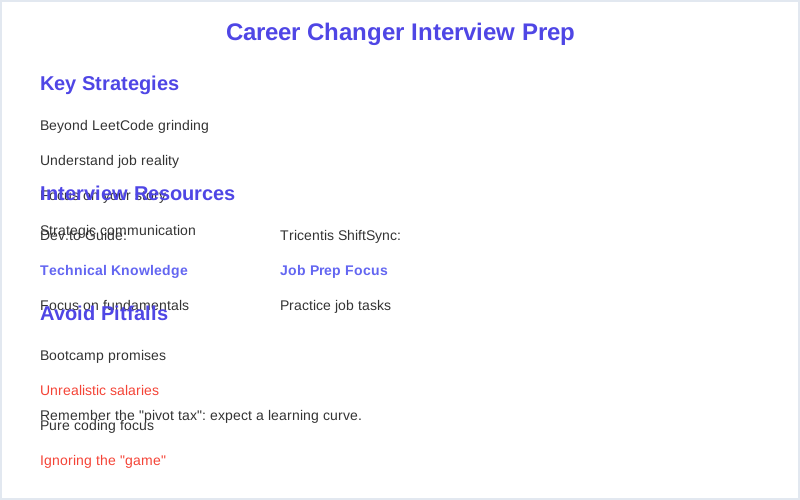
Dev.to's interview guide talks about technical knowledge; I'm here to talk about the reality of applying it.
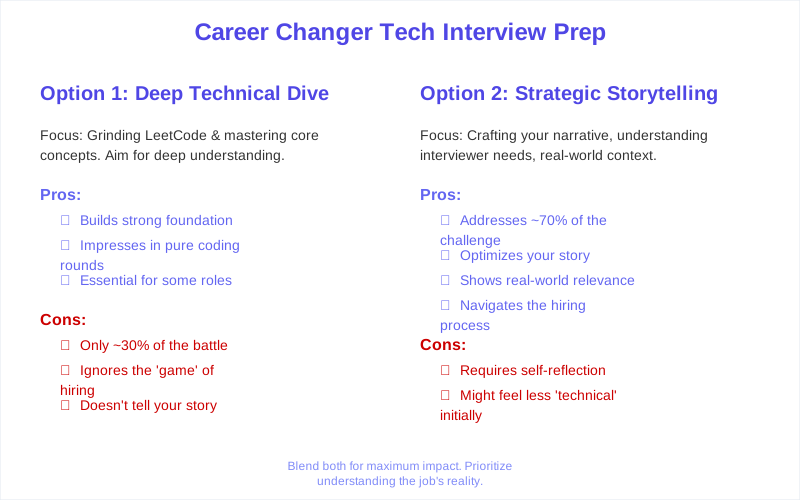
Career changers, listen up: preparing for technical interviews isn't just about grinding LeetCode. That's maybe 30 percent of the battle. The other 70 percent is navigating a hiring process designed for people who've already been doing the job for years. You're trying to prove you belong, often against candidates with 'ML' already stamped on their resume for five years straight. It's a tough pivot, and the 'pivot tax' is real, both in time and often initial salary.
Forget the bootcamp ads promising '$200K salaries in 12 weeks.' Those are selling a fantasy, not an actual career path. The unglamorous part of this journey involves way more self-reflection and strategic communication than pure coding prowess. You need to understand what interviewers are actually looking for, beyond the textbook answers.
I've seen too many smart people, brilliant engineers even, stumble because they didn't understand the game. They focused on optimizing their algorithms when they should have been optimizing their story. Tricentis ShiftSync emphasizes preparing for the job, not just the interview. That's the signal, not the hype. This article isn't about giving you a list of LeetCode problems; it's about giving you the operational reality of how to stand out when you're changing careers.
The Real Answer
The real answer is that interviews are less about finding the 'best' candidate and more about de-risking a hire. Especially for career changers, companies aren't just checking if you can code; they're checking if you're a safe bet. They're asking: can this person actually do the unglamorous 80 percent of the job, or are they just good at whiteboard problems? Reddit users discuss understanding what metrics companies track, and it's more than just code.
Think of it as a series of filters. The initial screening is a keyword filter, often run by an Applicant Tracking System (ATS). If your resume doesn't match 80 percent of the keywords, it might not even reach a human. This isn't personal; it's just automation.
Then comes the technical filter. This is where your ability to solve problems, not just recite solutions, comes into play. They want to see your thought process, how you debug, and how you communicate under pressure. It's less about finding the optimal solution on the first try and more about demonstrating resilience and a structured approach.
The behavioral filter is next, and this is where career changers often excel or completely bomb. You don't have years of direct ML experience. So, you need to translate your past experience into relevant skills: problem-solving, stakeholder management, dealing with ambiguity. A cheat sheet for interview prep highlights company research, which is crucial for framing these answers.
Finally, the culture fit. This isn't about being best friends with everyone. It's about demonstrating you can integrate into their existing team, communicate effectively, and handle the daily grind without becoming a liability. For career changers, showing adaptability and a hunger to learn is key. They're looking for someone who won't quit when the data pipelines inevitably break, which they will. Often, the actual job is more about fixing broken things than building shiny new ones.


What's Actually Going On
What's actually going on is that companies are trying to minimize risk and cost. Hiring is expensive, a bad hire even more so. The technical interview process, especially for career changers, is designed to stress-test your foundational skills and your ability to adapt. Course Report notes that AI is reshaping technical interviews, creating new questions about authenticity.
For smaller companies (under 50 employees), they might focus heavily on hands-on coding challenges or take-home projects. They need someone who can hit the ground running, so they're looking for immediate output. The 'move fast and break things' mentality means they want someone who can also 'fix things fast.'
Mid-sized companies (50-500 employees) often use a combination of coding, system design, and behavioral interviews. They're looking for both technical competence and team fit. Expect questions about how you handle conflicts or ambiguous requirements, because those are daily occurrences in a growing team. Matthew Bill on Medium suggests using the STAR method for behavioral questions.
Larger enterprises (500+ employees) have more structured processes, often involving multiple rounds and specialized interviewers. You'll face dedicated system design interviews (for mid-level and above), coding challenges, and extensive behavioral assessments. They have the resources to be picky and want candidates who fit into their established frameworks and often slower-moving processes.
ATS data shows that resumes with 'ML' in the job title get a 20 percent higher callback rate than those without, even if the underlying skills are identical. This is the 'signal vs hype' problem in action. For career changers, this means you need to get creative about how your past experience maps to these keywords. It's not about lying; it's about translating.
Regulatory facts: companies are increasingly wary of 'proxy' hiring, where someone else helps with a take-home project. This means live coding and detailed whiteboarding are making a comeback. They want to see your brain at work, not ChatGPT's. The days of just submitting a perfect GitHub repo are fading; they want to see you build it, or at least explain it, in real time.


How to Handle This
Alright, enough with the philosophy. Here's how to actually handle this mess. First, commit to 15-20 hours a week for 3-6 months. This isn't a side project; it's a second job if you want to make a serious pivot. YouTube guides on mastering tech interviews often understate the time commitment.
Step 1: Foundational Skills (Months 1-2). Don't just watch tutorials. Implement data structures and algorithms from scratch in Python or Java. Focus on arrays, hash maps, trees, and graphs. Understand time and space complexity like it's your personal mantra. Do 2-3 easy LeetCode problems daily, without looking at solutions for at least 30 minutes.
Step 2: Project-Based Learning & Portfolio (Months 2-4). Build 2-3 substantial projects that solve real problems, not just tutorial clones. Use real-world, messy datasets. Document everything. Deploy them if possible. A project that serves a simple prediction via a Flask API is worth 10 times more than a perfect Jupyter notebook. Columbia CCE resources emphasize reviewing basic knowledge, but practical application is key.
Step 3: System Design & Domain Knowledge (Months 3-5). For mid-level roles, you need to understand how large-scale systems are built. Read up on microservices, databases, caching, and message queues. For ML roles, this means knowing how models are deployed, monitored, and versioned. This is where the unglamorous 80 percent of the job comes in.
Step 4: Behavioral Storytelling (Ongoing). This is critical for career changers. Map your past experiences to the common behavioral questions using the STAR method. Practice explaining how your non-ML experience translates to collaboration, problem-solving, and dealing with ambiguity in a technical context. Write down 10-15 stories.
Step 5: Mock Interviews (Months 4-6). Schedule at least 5-10 mock interviews with experienced professionals. Use platforms like Pramp or find mentors. Get brutal, honest feedback. This is where you iron out your communication style and learn to think aloud. It's where you realize your brilliant solution isn't clear unless you explain it properly.
Step 6: Targeted Applications & Networking (Months 5-6). Don't spray and pray. Research companies that value your transferable skills. Network aggressively. A warm referral can bypass the ATS filter entirely, improving your chances by 200 percent. The pivot tax is real, but a strong network can lower it.


What This Looks Like in Practice
I watched a candidate with 15 years in finance try to pivot into data science. His resume was loaded with 'Excel modeling' and 'financial forecasting.' His first technical screen for a junior ML role involved coding a simple recommendation engine. He spent 20 minutes trying to remember Python list comprehensions. He failed.
Another scenario: a brilliant software engineer, switching to ML engineering, aced the coding challenge. But in the system design interview, when asked how he'd monitor model drift in production, he froze. He knew Docker and Kubernetes, but not the specific ML ops tools. He couldn't articulate the unglamorous part of the job.
Consider the 'take-home project' that asks you to build a simple API endpoint in 24 hours. I've seen candidates submit beautiful, complex models that didn't even run because they didn't account for dependencies or basic error handling. They optimized for model accuracy, not operational robustness. Substack discusses how to crack tech interviews, but real-world execution matters.
One time, a candidate for a data engineering role spent 30 minutes explaining a recursive algorithm to invert a binary tree. Impressive, sure. But when asked about optimizing a SQL query joining three large tables, he struggled. The actual job was 90 percent SQL, 10 percent Python scripting, zero percent tree inversions.
I personally remember an interview where I spent 10 minutes explaining why a particular model choice was robust to data drift, even though it had slightly lower initial accuracy. The hiring manager immediately perked up. He knew the pain of production models falling apart. This wasn't about the F1 score; it was about managing risk and operational reality. Career Plan Commons mentions reviewing basic knowledge, but also understanding the job's context.
These scenarios illustrate a pattern: interviewers, especially for career changers, are looking for transferable skills and an understanding of the entire lifecycle, not just the glamorous model-building part.


Mistakes That Kill Your Chances
Look, I've seen enough interview train wrecks to fill a book. Here are the common mistakes that will absolutely kill your chances, especially if you're a career changer trying to make a good impression. Reddit users share tips for 2026 interviews, but avoiding these pitfalls is step one.
| Mistake | Why It Kills Your Chances | The Actual Job Reality |
|---|---|---|
| Only grinding LeetCode Easy/Medium | Shows you can solve textbook problems, but not real-world ambiguity or complex system interactions. You lack depth. | Production systems are rarely 'easy' problems. They're messy, poorly documented, and require creative, often suboptimal, solutions. |
| Not understanding system design basics | Signals you only care about the algorithm, not how it integrates into a larger, functional product. You're a feature, not a system. | Your model needs to live somewhere. It needs data. It needs to be monitored. If you don't grasp this, you're a liability. |
| Vague or non-STAR behavioral answers | You can't articulate your impact or problem-solving process. It sounds like you're making things up or haven't reflected on your experience. | The unglamorous 80 percent of the job is problem-solving, stakeholder management, and communication. If you can't tell a coherent story, you can't do the job. |
| Ignoring company research | Comes across as uninterested, lazy, or generic. You're just applying to 'an' AI job, not *this* AI job. | Hiring managers want to feel special. They want to know you actually want to work *there*, on *their* problems. It shows genuine interest. |
| No deployed projects/real-world data | Signals you only work in Jupyter notebooks. You haven't dealt with the actual pain of getting something to work in production. | The gap between a Jupyter notebook and a production service is a chasm. Show you've at least peeked over the edge. |
| Treating the interviewer as a test-giver | You're not collaborating or asking clarifying questions. You're just trying to pass, not solve a problem together. | The actual job involves constant collaboration, asking 'dumb' questions, and iterating. Treat the interview as a preview of that. |
Every one of these mistakes screams 'high risk' to a hiring manager, especially when they're looking at a career changer. Don't be that person.
Key Takeaways
Pivoting into an AI career, especially as a career changer, is a marathon, not a sprint. The bootcamp promises are mostly hype; the real requirements are grit, strategic preparation, and an understanding of the unglamorous 80 percent of the job.
Here are the key takeaways I've learned from years in the trenches, the stuff LinkedIn won't tell you:
-
Focus on the Full Stack: Don't just build models. Understand data pipelines, deployment, monitoring, and infrastructure. Medium discusses preparing for coding interviews, but the full stack is often overlooked.
-
Translate, Don't Just List: Your past experience, no matter how unrelated, has transferable skills. Learn to translate them into the language of AI roles.
-
Practice Explaining: The math matters less than the communication. Can you explain an F1 score to a VP who thinks AI is magic? This is a crucial skill.
-
Build Real Things: A deployed project, even a simple one, is worth a hundred LeetCode problems. It shows you can deal with the ugly reality of getting things to work.
-
Network Aggressively: Warm referrals bypass the ATS and put a human face to your application. This is your biggest advantage as a career changer.
This isn't easy. The pivot tax is real. But if you put in the work, understand the actual job, and communicate your value, you'll find your way. It's about playing the long game, not chasing instant gratification.
Frequently Asked Questions
Should I pay for a premium LeetCode subscription or is the free tier enough for a career changer?
Do I really need to know Docker and Kubernetes if I'm applying for a junior ML role?
What if I build a portfolio project, but it's not 'cutting-edge' or doesn't use the latest LLMs?
Can focusing too much on behavioral questions make me seem less technical?
I heard that companies use AI to screen resumes and interviews now. Is it even worth applying if I don't perfectly match the job description?
Sources
- Interviews in 2026: The Preparation Guide : r/jobs - Reddit
- Tips for Tech Job Interview Preparation | by Matthew Bill - Medium
- How to Prepare for Tech Interviews: The Complete 2026 Guide
- How to Prepare for a Coding Interview in 2026 (Without Losing Your ...
- How to Prepare for a Technical Interview
- Complete Technical Interview Preparation Cheat Sheet.. This will ...
- Technical Interviews in 2026: How to Stand Out in the Age of AI
- Prep for 2026 interviews - free, 2 day bootcamp by hiring managers ...
- Prepare for a Software or Technical Interview - Columbia CCE
- How to Prepare for Interviews in 2026? - Tricentis ShiftSync
- Mastering Tech Interviews in 2026 - the AI Era - YouTube
- How to Crack Tech Interviews in 2026: A Complete and Practical ...