
How to Spot Interview Red Flags From the Company Side (2026 Complete Guide)
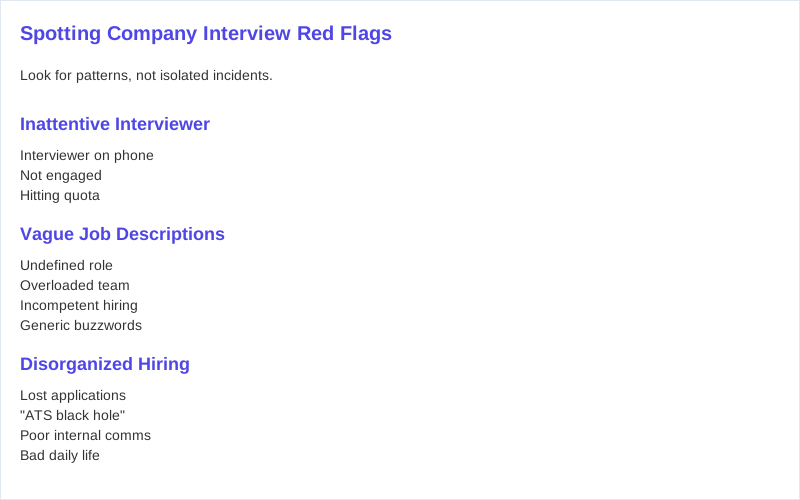
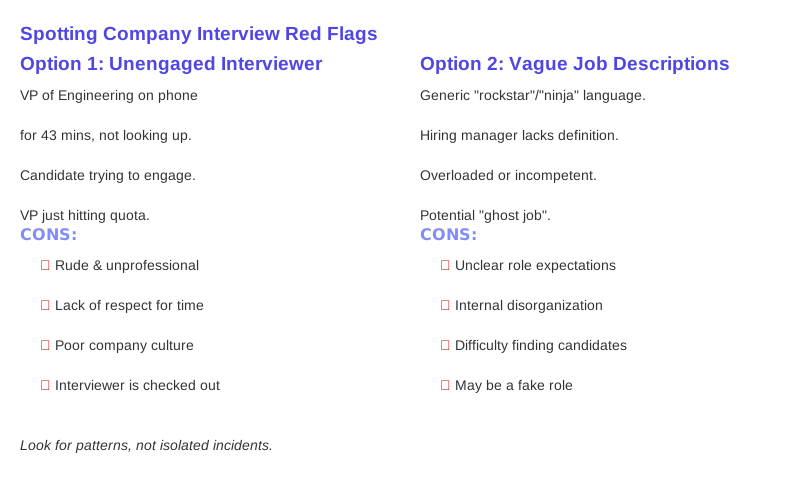
I've seen more red flags than a matador in a bullring. One time, I watched a VP of Engineering interview a candidate for 43 minutes without ever looking up from his phone. The candidate, bless his heart, kept trying to engage, but it was clear the VP was just there to hit his 'interview quota' for the week.
I've seen more red flags than a matador in a bullring. One time, I watched a VP of Engineering interview a candidate for 43 minutes without ever looking up from his phone. The candidate, bless his heart, kept trying to engage, but it was clear the VP was just there to hit his 'interview quota' for the week. That's not just rude; that's a company culture warning flare you can see from orbit.
Forbes talks about vague job descriptions, and they're right, but the real reason is often far deeper than just bad writing. It means the hiring manager hasn't bothered to define the role because they're either overloaded, incompetent, or the role itself is a ghost job. I've built enough reqs in Workday to know when the job description is just boilerplate. When I see generic 'rockstar' or 'ninja' language, my recruiter brain immediately flags it as signal vs noise.
It's often a sign that the company hasn't done the internal work to actually understand what they need. They're just throwing buzzwords at the wall hoping something sticks, and then I'm stuck trying to find a unicorn based on a fantasy. The resume graveyard is full of candidates who applied to those roles. The 'ATS black hole' is real, but so is the human disorganization behind it.
Trust me, I've had to explain to enough candidates why their application for a 'Senior Data Wizard' evaporated into the ether. It's not always malice, but it's rarely competence. When a company can't even get its internal ducks in a row for an interview, that's a strong indicator of what your daily life there will be like. It's not just about the job; it's about the entire hiring theater.
The Real Answer
The real answer to spotting company red flags isn't about looking for single, isolated incidents, but understanding the underlying hiring mechanics and recruiter workflow that cause them. It's a pattern recognition game. When a company's hiring team can't articulate the role's expectations, as highlighted by CNBC, it's not just a communication breakdown. It signals a lack of internal alignment, a common feature in companies that haven't invested in robust job architecture or even basic internal communications.
I've been in countless hiring committee meetings where the hiring manager, their director, and a peer interviewer all had wildly different ideas about what 'success' looked like for the same role. This isn't a minor hiccup; it means you're walking into a role with no clear path, no defined metrics, and likely, no support.
My recruiter brain immediately thinks, 'This poor candidate is going to spend six months figuring out what they're supposed to do, then get fired for not doing it.' Another major flag is evasion when you ask tough questions. HBR notes this, and from my side, it often means HR policy is preventing them from being transparent, or worse, they're actively trying to hide something.
I once had a hiring manager refuse to answer a candidate's question about team turnover, citing 'proprietary data.' The real reason? Their team had a 90 percent attrition rate in the last year. That's not a red flag; that's a flaming meteor heading for impact. The entire interview process is a two-way street, and if they're not willing to be transparent, they're not worth your time. Your intuition about a company's behavior during the interview process is usually spot-on.


What's Actually Going On
When a company reschedules your interview three times, it's not always because someone got sick. In Greenhouse or Lever, rescheduling is a single click, but constant changes often point to a lack of respect for candidate time, or worse, internal chaos. My recruiter brain sees this as a symptom of a larger problem, often involving a hiring manager who's completely swamped and prioritizing everything but hiring. Or, it's a ghost job and they're just stringing you along.
If they say 'we're like a family,' as Reddit hilariously points out, run. I've heard this line a hundred times, and it universally means 'low pay, long hours, and emotional manipulation.' HR policy often allows for vague 'culture fit' language, but 'family' is a specific kind of toxic. It implies you owe them loyalty beyond a paycheck, which is a convenient way for them to exploit you.
When I hear a candidate parrot back generic mission statements, it's a red flag for me, but the inverse is true for companies. If they can't move beyond the marketing fluff, they likely lack substance. Disorganized communication, like a different interviewer asking the same questions, is a classic sign of a fragmented process, which can lead to a really frustrating employee experience. LinkedIn News agrees this signals deeper issues.
I've seen Workday instances where interviewer feedback wasn't properly synced, leading to candidates being asked about their greatest weakness three times. It's not just annoying; it reflects a systemic lack of process that will bleed into your daily work. If they can't manage a simple interview loop, imagine their project management. The absence of clear performance metrics for the role is another colossal red flag.
If they can't tell you what 'success' looks like in 30, 60, or 90 days, they haven't thought it through. This often means they'll move the goalposts on you, or worse, they're just looking for someone to blame when things go sideways. I've seen this happen too many times, and it's a direct path to burnout.


How to Handle This
When you encounter a red flag, don't ignore it. First, document it. Note the specific behavior, the date, and the person involved. This isn't just for your memory; it helps you connect patterns. For example, if the hiring manager avoids salary questions, note it. If HR then gives a vague range, you've got two data points. Second, ask clarifying questions, politely but directly.
If a job description is vague, ask 'What are the top three priorities for this role in the first 90 days?' or 'How is success measured for this position?' This forces them to articulate the role beyond platitudes. Recruitee emphasizes pinpointing problem areas, and direct questions are your best tool. Third, pay close attention to how they answer. Do they pivot? Do they get defensive? Or do they provide concrete, specific examples?
Evasive answers, as CEO Monthly notes, are a major warning sign. If they dodge a question about high turnover, it's not because they can't remember; it's because they're hiding something. Fourth, look for consistency across interviewers. If one person says the team is 'collaborative' but another describes a 'solo contributor' environment, that's a disconnect.
I once had a candidate ask me, 'Why did the hiring manager say this role reports to the Director, but the VP of Talent said it reports to the Senior Manager?' That kind of internal inconsistency screams disorganization. Fifth, leverage your network. Reach out to current or former employees on LinkedIn, especially if you have a second-degree connection. Ask about the culture, the leadership, and the 'real' expectations of the role.
People are surprisingly candid when approached respectfully outside the hiring theater. Their insights can confirm or deny your red flag suspicions.


What This Looks Like in Practice
Let's say you're interviewing for a 'Senior Product Manager' role. The job description in Lever lists 8 core responsibilities, but in your first interview, the hiring manager focuses on only one: 'fixing our legacy product's bug backlog.' This is a 7-point discrepancy. That's not just a red flag; that's a bait-and-switch. Your recruiter brain should immediately interpret this as the company needing a glorified project manager for technical debt, not a strategic product leader.
If the interview process is constantly delayed, with 3+ reschedules, it's not just bad luck. My internal tracking in iCIMS showed average time-to-hire for senior roles at 45 days. If yours is already at 90 days with no clear end, it indicates a lack of urgency or internal disarray. Aquent highlights vague job descriptions, and this is a classic example.
You ask about career progression, and the interviewer says, 'We're a flat organization here, everyone wears many hats.' This isn't a badge of honor; it's a warning. It almost always means no clear promotion path, no defined roles, and an expectation that you'll do the work of three people for the salary of one. I've seen this play out with countless candidates who felt trapped after six months.
If your interviewers can't articulate how the company makes money or what its core product differentiator is, that's a huge problem. I once interviewed a candidate for a B2B SaaS company, and they couldn't explain our value proposition to customers. That's a fundamental disconnect. If the company itself can't clearly define its purpose, how can you contribute meaningfully? This often happens in startups with a lot of 'hiring theater' but no actual product-market fit.

Mistakes That Kill Your Chances
| Mistake | Why It Kills Your Chances (from the company side) | The Real Reason |
|---|---|---|
| Ignoring your gut feeling | Dismissed as 'overthinking' or 'being too picky' | Your intuition picked up on subtle cues that HR policy or a recruiter's workflow can't explicitly address. |
| Not asking enough questions | Perceived as disinterest or lack of critical thinking | The company views candidates with no questions as unprepared or uninterested in evaluating the role, a key part of the two-way interview. ADP notes this as a sign of lack of interest. |
| Accepting a vague job description | Seen as being 'flexible' or 'easy to manage' | A vague job description means the company hasn't done the internal work. You'll be setting your own goals with no clear path. |
| Not researching the company beyond its website | Indicates a superficial interest in the role | Recruiters expect candidates to dig deeper than marketing fluff. My recruiter brain flags those who only parrot the 'About Us' page. |
| Not verifying inconsistent information | Signals a lack of attention to detail or critical judgment | If you hear conflicting information from different interviewers, and don't clarify, it shows you're not paying attention to the details. |
| Focusing only on salary and benefits | Suggests a transactional mindset, not a long-term fit | While important, making these your *only* questions implies you're not invested in the role's substance or the company's mission. |
| Not checking Glassdoor/Reddit for reviews | Shows a lack of due diligence, or naivete | Companies know these sites exist. Not checking them implies you're not doing your homework, or you're willing to ignore obvious issues. Forbes mentions the 'family' red flag, often found in these reviews. |
- **Inconsistency is a tell:** If interviewers can't agree on the role, the culture, or the company's direction, that's a major red flag. This often points to internal conflict or disorganization that will impact your daily work.
- **Vagueness is a warning:** Generic job descriptions and evasive answers mean they haven't done their homework, or worse, they're hiding something. Force them to be specific.
- **Process reflects culture:** A disorganized hiring process, constant rescheduling, or poor communication during the interview is a preview of what working there will be like. Four Squared highlights poor communication as a red flag.
- **'Family' means trouble:** When a company uses terms like 'family,' it almost universally signals an expectation of overwork and underpayment. Trust me, I've seen the turnover rates.
- **Trust your gut:** Your instincts are usually right. If something feels off, it probably is. Don't let the allure of a new job blind you to obvious warning signs.
Frequently Asked Questions
What's the actual cost difference if I ignore a red flag about a disorganized hiring process?
Do I really need to check Glassdoor and Reddit, or is that just for disgruntled employees?
What if I ask clarifying questions about a vague job description and they still give me a generic answer?
Can accepting a 'ghost job' permanently damage my career reputation?
I heard that if a company asks me to do a 'take-home assignment,' it's always a red flag. Is that true?
Sources
- How To Spot Red Flags in Job Interviews - LinkedIn
- 3 Red Flags To Spot In A Job Interview (Before You Accept The Offer ...
- Job Interview Red Flags—Learn How To Spot Exaggeration - Forbes
- Do You Know How To Spot Job Interview Red Flags? - Aquent
- How to Spot Red Flags During the Hiring Process - CEO Monthly
- Top 3 red flags job seekers should watch out for in interviews, says ...
- A Cool Guide to Interview Red Flags: Resolution fixed - Reddit
- 5 Interview Red Flags Employers Should Not Ignore in 2026
- 35 interview red flags (+ tips for how to find them) - Recruitee
- 10 Red Flags to Watch Out for in a Job Interview
- 7 Potential Job Interview Red Flags - ADP