What to Do If You Suspect You Were Rejected for Your Age (2026 Complete Guide)
RoleAlign Team
15 min read
Prices verified February 2026
Includes Video
You just received another rejection email. The phrasing is standard, polite, and utterly unhelpful. You've been meticulously preparing for interviews, honing your skills, and tailoring your resume, only to be met with a digital "no." This feels familiar, and you can't shake the nagging suspicion that your age, not your qualifications, is the real reason you were overlooked.
You just received another rejection email. The phrasing is standard, polite, and utterly unhelpful. You've been meticulously preparing for interviews, honing your skills, and tailoring your resume, only to be met with a digital "no." This feels familiar, and you can't shake the nagging suspicion that your age, not your qualifications, is the real reason you were overlooked. This isn't just a hunch; you're not alone in this experience. In fact, in 2021, a Centers for Disease Control report highlighted an AARP survey where 61% of participants aged 50 and older reported experiencing or witnessing age-based discrimination at work. This pervasive issue can manifest in subtle ways, from interviewers focusing on your perceived lack of "energy" or "adaptability" to job descriptions that implicitly favor younger candidates. The Age Discrimination in Employment Act of 1967 (ADEA) makes it illegal to discriminate against those 40 and older, yet it remains a pervasive issue, often subtle and challenging to prove. Sometimes, as one Quora user noted, the fact that you received interview calls can indicate the company was aware of your age and still chose to proceed, making the subsequent rejection particularly disheartening. If you suspect you've been subject to age discrimination job rejection, understanding your next steps is crucial for asserting your rights and seeking recourse. It's important to remember that challenging ageist behavior is possible, both in the workplace and during the hiring process.
Key specifications for What to Do If You Suspect You Were Rejected for Your Age
## The Real Answer
The core truth from the recruiting side: while illegal, age discrimination is common and difficult to prove. Recruiters often rely on subtle biases and stereotypes, making direct evidence of age bias in a job rejection rare, even when it's the underlying reason.
If you suspect you were rejected for your age, understand that the system is often designed to obscure this. Recruiters might not explicitly state age as a reason; instead, they'll focus on perceived "fit" or "energy" that can be proxies for age bias. While laws like the Age Discrimination in Employment Act (ADEA) protect those 40 and older How to Prove Age Discrimination in the Hiring Process, proving intent is the major hurdle.
You need to assess if you were truly the most qualified candidate. If you were, then consider if questions during the interview hinted at age bias, such as inquiries about retirement plans or how long you intend to work How Can I Prove Age Was the Reason I Wasn't Hired?. Also, look at the qualifications of the person hired; if they significantly lack your experience, it could be a red flag.
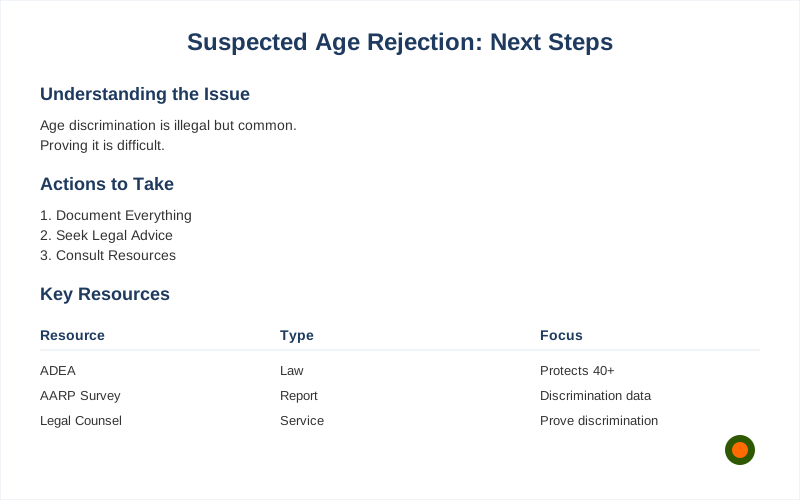
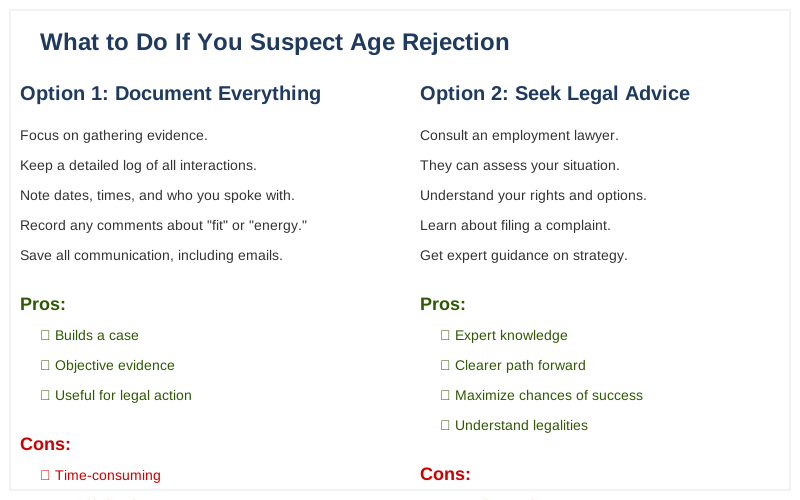
While it's challenging to prove age discrimination job rejection, documenting everything is crucial. Keep notes on interview conversations, job descriptions, and the profiles of those hired. Remember, you have rights, and if you believe you've been mistreated, seeking legal counsel is a vital step to assert them.
Understanding how algorithms can amplify biases is crucial, especially when considering how age discrimination plays a role in hiring practices.
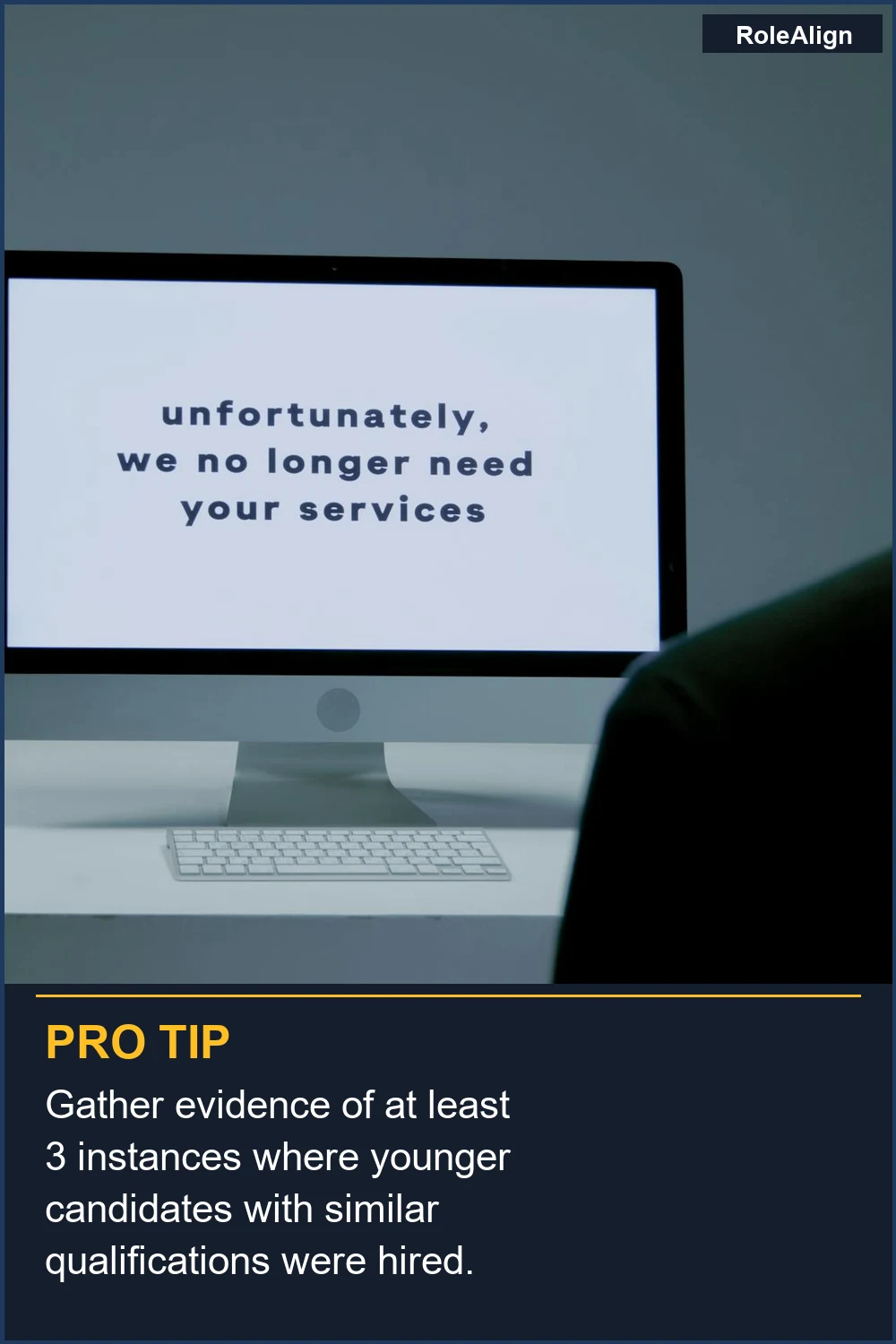
A stark computer screen showing a rejection message underscores the reality of age bias in job rejections, a common hurdle for experienced professionals.
| Photo by Ron Lach
A stark computer screen showing a rejection message underscores the reality of age bias in job rejections, a common hurdle for experienced professionals.
| Photo by Ron Lach
## What's Actually Going On
1
ATS Screening - Applicant Tracking Systems (ATS) like Workday or Taleo parse resumes for keywords matching the job description to identify candidates meeting minimum qualifications. An ATS can penalize older candidates if their resumes lack current industry jargon or list experience exceeding the system's parsing capabilities. For instance, older workers may have resumes flagged as irrelevant due to outdated technology or methodologies. This can happen if the ATS is programmed with a limited scope of acceptable terms, inadvertently filtering out seasoned professionals whose experience, while extensive and valuable, predates the newest buzzwords. The system might also struggle to interpret older file formats or exceedingly long work histories, leading to a premature disqualification before a human ever sees the application.
2
Recruiter & Hiring Manager Review - Recruiters screen for skills, experience, and cultural fit, seeking candidates who can solve specific problems. In tech, this means evaluating experience with programming languages or cloud platforms; in finance, it's regulatory knowledge and deal-making experience. For senior roles, emphasis is on leadership, strategic thinking, and a proven track record. Unconscious bias can lead to an age bias interview, where recruiters might perceive older candidates as less adaptable or more expensive. The Age Discrimination in Employment Act of 1967 (ADEA) protects individuals 40 and older from such discrimination. Recruiters might unconsciously favor candidates who remind them of themselves or colleagues they perceive as more dynamic, even if the older candidate possesses superior qualifications. For example, a hiring manager might question an older candidate's willingness to work long hours or adapt to a rapidly changing team dynamic, assumptions not based on the candidate's actual abilities but on age stereotypes. Some individuals over 50 have reported being repeatedly rejected for jobs despite having extensive experience and qualifications, leading them to suspect age bias as a factor .
3
Hiring Committee Decisions - For critical hires, hiring committees assess candidates against long-term potential, team synergy, and company values. Startups may prioritize adaptability and a "roll-up-your-sleeves" attitude over extensive experience. Enterprise companies often focus on quantifiable achievements and established protocols. Healthcare roles heavily weigh regulatory compliance and patient care experience, where age can be perceived as a proxy for experience and trustworthiness. However, even in fields that value experience, committees might still harbor biases. A committee might select a candidate who is a "good, but not great fit" because they are younger, believing that a less experienced candidate might be more malleable or less likely to challenge established norms . This can be particularly frustrating when an older candidate possesses a wealth of knowledge and a proven history of success that would clearly benefit the organization.
4
Industry and Company Size Nuances - In fast-paced tech, recruiters may favor candidates with recent experience in cutting-edge tools, overlooking deep expertise in older, relevant technologies. Discrimination remains common. Finance firms often value long, stable careers but may be wary of perceived resistance to new financial technologies. Healthcare values experience but may consider age in relation to physical demands or perceived energy levels. For example, a startup might explicitly state a preference for a "young and dynamic team," which, while not directly stating an age preference, can be a coded way to exclude older applicants. Conversely, some industries might implicitly signal a preference for younger candidates by focusing heavily on social media presence or requiring extensive experience with platforms that are more popular among younger generations.
5
Subtle Indicators of Rejection for Age - Subtle cues can suggest an age discrimination job rejection, such as questions about retirement plans, intended tenure, or comments about a team's "energetic" or "young" culture. If you were highly qualified and these indicators were present, investigation may be warranted. Ageism and age discrimination are pervasive. If you are 40 or older and suspect mistreatment, you may be entitled to remedies. These subtle indicators, though seemingly innocuous, can reveal underlying biases. For instance, asking about how long you plan to work or if you're "ready for a change" might be veiled attempts to gauge your age and potential for longevity with the company. Similarly, comments about needing someone who can "keep up with the pace" or "fit in with the younger crowd" can be red flags. If you suspect you've been unfairly rejected due to your age, it's important to document these instances and consider consulting with an employment lawyer to understand your rights and options for pursuing a claim . Proving age discrimination can be challenging, but a pattern of subtle remarks or consistent rejection of highly qualified older candidates can build a case.
Understanding age-related rejections can also shed light on the nuances of being deemed overqualified for a position.
Confronting online ageism, this senior man's experience reflects the challenges of age bias during the job search, especially with ATS screening.
| Photo by Ron Lach
Confronting online ageism, this senior man's experience reflects the challenges of age bias during the job search, especially with ATS screening.
| Photo by Ron Lach
## How to Handle This
1
Document Everything - If you suspect age discrimination, meticulously record every interaction: dates of application, interview times, interviewer names, and exact phrasing of age-related questions. Subtle comments about "energy," "cultural fit," or "how long you plan to stay" can be indicators. Gathering these details is crucial because proving age discrimination requires evidence, not just a hunch. Note down any instances where a younger, less experienced candidate was hired over you, especially if the interviewer made comments suggesting a preference for youth. Keep copies of job descriptions, your resume, and any correspondence. Even seemingly innocuous remarks can become significant when pieced together, forming a pattern of bias. For instance, if an interviewer asked about your retirement plans or how you keep up with new technology, these could be red flags. The more detailed your records, the stronger your case if you decide to pursue legal action.
2
Assess Your Qualifications Objectively - Critically evaluate if you were the most qualified candidate. Compare your skills, experience, and education against the job description and, if possible, the hired person's profile. If you were demonstrably more qualified, the suspicion of age discrimination strengthens. This is important for roles with rapid technological shifts, where younger candidates might be perceived as more up-to-date. Consider if your experience aligns with evolving industry standards. Were there specific skills mentioned in the job posting that you possess in abundance, perhaps even more so than a younger applicant? Conversely, if you feel you lacked certain cutting-edge skills, it's important to acknowledge this for a balanced assessment. However, if the employer's stated requirements were met or exceeded by your profile, and a younger candidate was chosen, this disparity warrants further investigation into potential age bias. Sometimes, companies may have unstated preferences, and it's your job to identify if age was an unstated factor.
3
Seek A Second Opinion (and Potentially Legal Counsel) - If documentation and self-assessment suggest potential age bias, consult an employment lawyer specializing in age discrimination. They can assess your evidence and advise. If you are 40 or older, you are protected by the Age Discrimination in Employment Act (ADEA), which prohibits discrimination against this age group. Many attorneys offer free initial consultations. A lawyer can help you understand the strength of your case and the legal options available. They are adept at recognizing patterns of discrimination that an individual might overlook. They can also guide you through the process of filing a complaint with the Equal Employment Opportunity Commission (EEOC) or a state agency, or pursuing a lawsuit. Remember, proving age discrimination can be challenging, and professional legal guidance is invaluable. Don't hesitate to reach out; seeking advice is a proactive step in asserting your rights and potentially rectifying an injustice. Speaking with an attorney is a crucial step to assert your rights.
4
Re-evaluate Your Job Search Strategy - While pursuing a claim, refine your approach. Update your resume to highlight recent achievements and skills, especially those related to current trends and technologies. Consider using a resume scanner like Jobscan to optimize for Applicant Tracking Systems (ATS). For roles where age bias is a concern, network through industry events or professional organizations. Tailoring your resume and application strategy can make you more competitive. Focus on showcasing your adaptability and eagerness to learn. Frame your experience not as "old" but as "seasoned" and "proven." Emphasize accomplishments that demonstrate your ability to stay current and contribute fresh perspectives. Networking can bypass traditional application processes and allow you to be recommended by trusted sources, potentially mitigating age bias. Consider targeting companies known for their commitment to diversity and inclusion. Sometimes, a subtle shift in how you present yourself can make a significant difference in overcoming perceived age-related barriers. Challenging ageist behavior starts with strategic self-presentation and proactive networking.
Navigating job transitions can be challenging, so it's important to also know how to handle setbacks like rejection by reading about job rejection motivation.
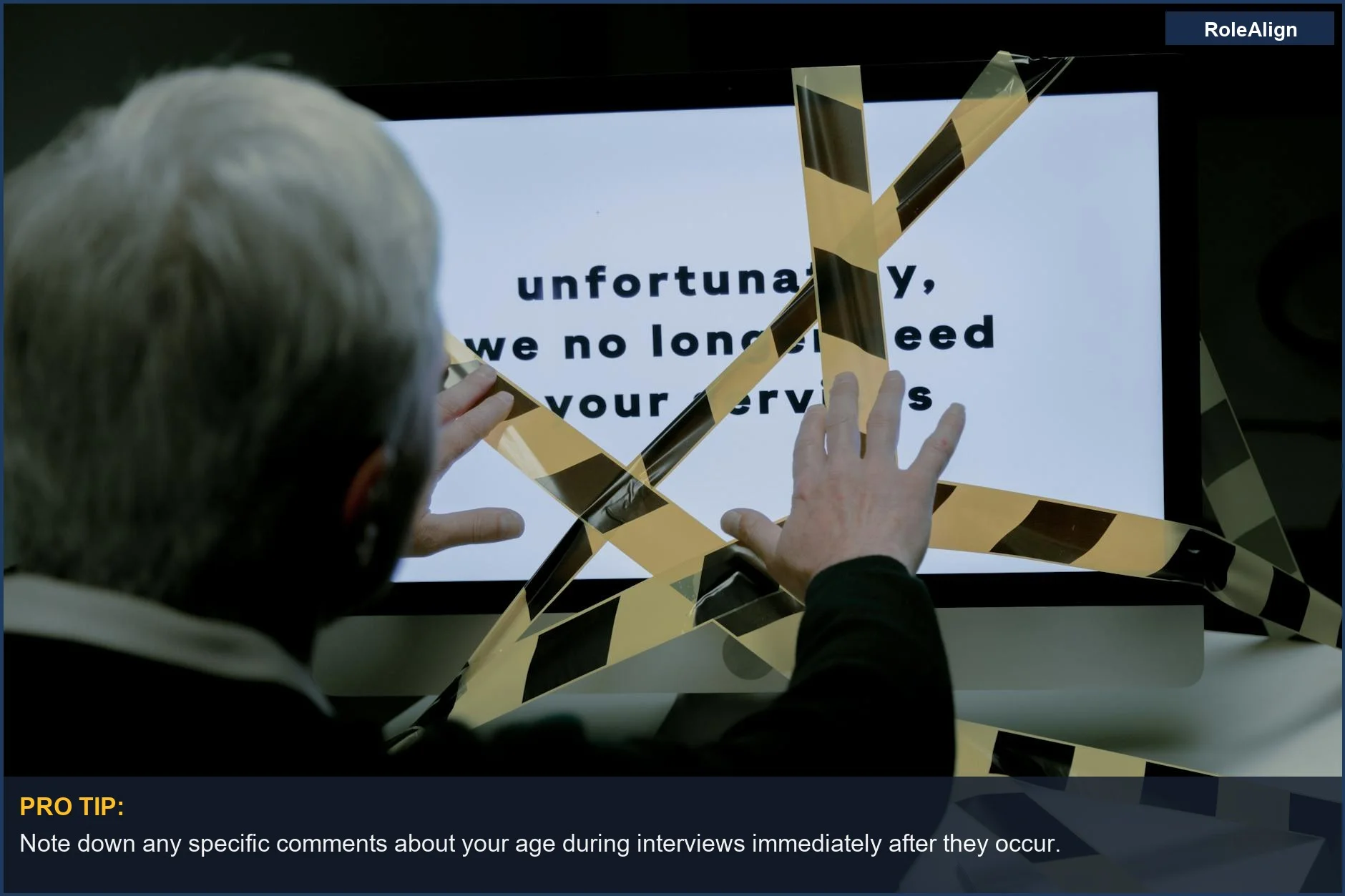
Facing age discrimination on a computer screen, this man's job search frustration highlights the importance of documenting every interaction to combat bias.
| Photo by Ron Lach
Facing age discrimination on a computer screen, this man's job search frustration highlights the importance of documenting every interaction to combat bias.
| Photo by Ron Lach
## What This Looks Like in Practice
Senior Software Engineer at a Large Tech Company. After extensive interviews, a candidate with significant experience and leadership roles, over 40, received a generic rejection. This occurred despite strong qualifications, while younger, less experienced candidates reportedly advanced, suggesting subtle age bias. The phrasing of the rejection was notably vague, lacking any specific feedback on technical skills or interview performance. This lack of concrete reasons, coupled with the perceived advancement of less qualified but younger individuals, can be a strong indicator of age-based discrimination, even if not explicitly stated. How to Prove Age Discrimination in the Hiring Process
Entry-Level Data Analyst at a Well-Established Financial Institution. A recent graduate with a strong academic record and relevant internships was told by the hiring manager that the team needed someone to "hit the ground running" without a steep learning curve. The candidate was qualified but passed over for someone perceived as a quicker fit, raising suspicion of age bias. This scenario highlights how employers might use seemingly neutral phrases to mask ageist preferences, implying that an older candidate might inherently require more training or be slower to adapt, even when evidence suggests otherwise. The emphasis on immediate productivity can be a veiled attempt to avoid candidates perceived as less digitally native or adaptable to fast-paced environments. How Can I Prove Age Was the Reason I Wasn't Hired?
Mid-Career Project Manager in Healthcare. A candidate with a proven track record in complex healthcare projects applied for a senior role. The interviewer focused on the candidate's tenure and asked about adapting to new technologies, perceived as veiled inquiries about comfort with modern tools. Despite demonstrating adaptability, an unspecific rejection fueled concerns about age bias. Questions about adapting to new technologies, especially when the candidate has a history of successful project management, can be a dog whistle for age concerns. The rejection citing a lack of "cultural fit" or similar vague reasons can be a way to avoid directly addressing age, a tactic that can be difficult to prove but is often suspected. How to Avoid Age Discrimination When Applying for a Job
Career Changer from Education to UX Design. After retraining in UX design, a former high school teacher applied for an entry-level UX role. While the portfolio was well-received, the interviewer focused on the candidate's previous career, asking about transitioning from teaching to tech. The rejection cited a lack of "cultural fit," a euphemism that can mask ageism. This example demonstrates how an interviewer might scrutinize a career change from an older applicant more intensely than from a younger one, focusing on perceived gaps or lack of immediate industry immersion rather than the acquired skills and potential. The "cultural fit" justification is notoriously subjective and can be a convenient cover for discriminatory reasoning, particularly when the candidate has a well-developed portfolio and relevant training. Ageism and Age Discrimination
As you seek greater growth opportunities, you might also consider how to address being overqualified for a job in the process, which can be challenging.
An elderly man's reaction to a dismissal message on his computer illustrates the impact of ageism and unemployment, a painful outcome of bias.
| Photo by Ron Lach
An elderly man's reaction to a dismissal message on his computer illustrates the impact of ageism and unemployment, a painful outcome of bias.
| Photo by Ron Lach
## Mistakes That Kill Your Chances
Signal A resume packed with jobs from 15+ years ago, or mentioning outdated technologies/certifications.
Fix Focus your resume on the last 10 years of relevant experience. For senior roles, this means highlighting recent leadership and strategic impact, not listing every project from your early career. Recruiters scan for current relevance, not a historical archive. This Facebook post advises keeping the resume to the last decade.
Symptom Assuming an interview means you're a good fit, then wondering why you were rejected for age.
Signal Getting multiple interview calls but no offers, especially for roles where you feel qualified.
Fix Recognize that getting an interview doesn't guarantee a match. A Quora discussion points out that interview calls mean they *knew* your age and still called. The problem might be a subtle disconnect in skills or cultural fit, or yes, age bias. You need to assess if you were truly the most qualified before concluding age discrimination is the sole reason.
Symptom Focusing solely on "fighting" ageism rather than demonstrating current value.
Signal Interview conversations dominated by discussions of past successes without connecting them to future needs, or expressing resentment about potential bias.
Fix Shift the narrative from defending your age to showcasing your current capabilities and forward-thinking approach. Research industry trends and demonstrate how your experience is an asset for today's challenges. Avoiding age discrimination involves proactive skill alignment, not just reactive defense. This is especially critical for mid-career and senior candidates.
Symptom Believing that emphasizing a "growth mindset" inherently negates age bias.
Signal Using buzzwords like "growth mindset" or "lifelong learner" without concrete examples of recent skill acquisition or adaptation.
Fix Prove your adaptability with specific, recent examples. Instead of just saying you have a growth mindset, detail a time you learned a new programming language, mastered a new AI tool like ChatGPT, or adapted to a significant industry shift in the last 2-3 years. General statements fall flat; demonstrable evidence of current relevance is key.
Understanding your rights can be crucial during interviews, especially regarding what employers cannot legally ask.
Product comparison for What to Do If You Suspect You Were Rejected for Your Age
## Key Takeaways
Focus on skills and experience, not age. If you suspect age discrimination job rejection, it's often subtle and hard to prove. Build your case with concrete evidence.
If you suspect you were rejected for your age, remember that while direct proof is tough, suspicious interview questions or a pattern of rejections after strong interviews can be indicators How Can I Prove Age Was the Reason I Wasn't Hired?.
Age bias interview tactics can include inquiries about retirement plans or long-term work intentions, suggesting an employer seeks younger candidates How Can I Prove Age Was the Reason I Wasn't Hired?.
Document everything: Keep records of job descriptions, your qualifications, interview notes, and correspondence. This is crucial if you explore legal avenues, as laws like the ADEA protect those 40 and older How to Prove Age Discrimination in the Hiring Process.
Build resilience: Embrace "rejection therapy" by intentionally seeking challenging situations. This clarifies goals and builds confidence, reducing the sting of a "no"
I'm over 40 and feel like I'm getting rejected for jobs because of my age. What should I do?
If you suspect you're being rejected for jobs due to your age, start by assessing if you were truly the most qualified candidate for the position compared to others. Document any questions asked during the interview that seemed to focus on your age, retirement plans, or how long you intend to work. Also, consider if any stated hiring requirements seemed unusually difficult for someone of your age to meet, even if they didn't directly mention age.
How can I tell if my job rejection was due to age bias?
It can be difficult to get direct proof of age bias in a job rejection, but look for patterns and subtle clues. Did the interviewer ask questions like 'Are you nearing retirement?' or 'How long do you plan to stay with the company?' Such questions can indicate age bias. Also, compare the qualifications of the person hired to yours; if you were clearly more qualified but not selected, it's worth considering age as a factor.
I'm convinced I was rejected for a job because I'm too old. What are my next steps?
If you believe you've experienced age discrimination in a job rejection, your best course of action is often to consult with an employment attorney who specializes in age discrimination cases. They can help you understand your rights and gather evidence to build a case. Document everything, including interview notes, job descriptions, and communications with the employer.
What legal options do I have if I think a company rejected me for a job because of my age?
Federal law, like the Age Discrimination in Employment Act (ADEA), protects individuals aged 40 and older from age-based discrimination in hiring by employers with 20 or more employees. If you suspect this has happened, you can explore filing a complaint with the Equal Employment Opportunity Commission (EEOC) or consult with an attorney to discuss potential legal action and remedies.
After multiple interviews, I was told I wasn't a good fit, and I suspect it's my age. What should I do?
While 'not a good fit' can be a vague reason, if you have strong suspicions of age bias, it's important to gather any evidence you can. This might include notes from the interview about comments made, or patterns of rejections despite strong qualifications where age might be a factor. Speaking with an employment lawyer can help you assess the strength of your case and decide on the best strategy.
R
RoleAlign Team
Experienced car camper and automotive enthusiast sharing practical advice.