Employment Rights

What to Do If Your Employer Misclassifies You As a Contractor (2026 Complete Guide)

RoleAlign Team
17 min read
Prices verified February 2026
Includes Video

You just spent hours tailoring your resume and prepping for that big interview, only to land the job and find yourself classified as an independent contractor. This isn't just a minor administrative detail; it can significantly impact your wages, taxes, and access to benefits.

You just spent hours tailoring your resume and prepping for that big interview, only to land the job and find yourself classified as an independent contractor. This isn't just a minor administrative detail; it can significantly impact your wages, taxes, and access to benefits. Misclassification of workers as independent contractors is a widespread issue, with some studies estimating that 10% to 30% of employers misclassify their workers Independent contractor misclassification: 2026 guide & best practices. This practice denies legitimate employees protections and can result in employers saving significantly on payroll taxes and benefits Independent contractor misclassification: 2026 guide & best practices. If you believe your employer has wrongly classified you as a contractor, you're not alone, and there are steps you can take. Understanding the difference between an employee and a contractor is crucial, as employees are entitled to minimum wage and overtime pay under the Fair Labor Standards Act (FLSA) Misclassification of Employees as Independent Contractors Under .... This guide will equip you with the knowledge to navigate this complex situation and understand your rights.

The implications of being misclassified are substantial. As an independent contractor, you are responsible for paying your own self-employment taxes, including Social Security and Medicare, which an employer would typically split with an employee. Furthermore, you likely won't have access to employer-sponsored benefits such as health insurance, paid time off, retirement plans like 401(k)s, and unemployment insurance. This can lead to a significant financial disadvantage compared to your properly classified colleagues. The IRS and Department of Labor utilize various tests, often focusing on the degree of control an employer has over the worker, to determine the correct classification. Factors such as how the work is performed, the level of supervision, the permanency of the relationship, and whether the worker's services are integral to the employer's business operations are all considered. If you find yourself in this situation, it's important to first confirm your classification by reviewing your work arrangement and tasks, and sometimes, an honest conversation with your employer might be the first step, as misclassification can sometimes be an oversight What to Do if You're Being Misclassified by Your Employer. However, if the misclassification persists or appears intentional, understanding your legal recourse becomes paramount.
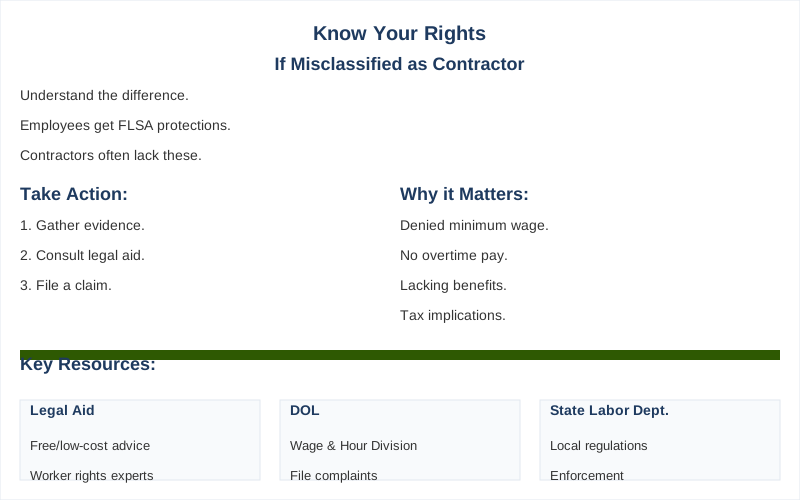
Infographic: Employer misclassification comparison chart.
Key specifications for What to Do If Your Employer Misclassifies You as a Contractor

The Real Answer

The core issue with employer misclassification isn't a gray area; it's a deliberate strategy to cut costs by denying workers employee benefits and protections. Recruiters and HR departments often push this because it simplifies payroll and reduces overhead, but it's legally precarious.

From a recruiter's perspective, classifying someone as a contractor often means avoiding payroll taxes, benefits administration, and the complexities of employment law. It's a shortcut. However, the law, particularly the Fair Labor Standards Act (FLSA), looks at the reality of the work relationship, not just the label. If your employer dictates how, when, and where you work, provides equipment, and you primarily work for them, you're likely an employee, not an independent contractor. A recent study estimated that as many as 10% to 30% of employers misclassify their workers, often denying them minimum wage and overtime pay Independent contractor misclassification: 2026 guide & best practices.

This misclassification harms workers by withholding rightful protections and benefits. Misclassified employees may not receive minimum wage, overtime pay, or access to unemployment insurance and workers' compensation Misclassified Workers | Department of Labor and Industry. The IRS also imposes penalties; for instance, they can charge $340 for every missing 1099 form 1099 Form Guide 2026: Avoid Worker Misclassification | DianaHR.

The economic reality test is key. This involves examining factors like behavioral control (who directs the work), financial control (who invests in the work), and the nature of the relationship. For 2026, the reporting threshold for 1099 forms has increased to $2,000, but this change does not alter tax liability or the underlying classification requirements 1099 Form Guide 2026: Avoid Worker Misclassification | DianaHR.

If you suspect employee vs contractor misclassification, the first step is to confirm your classification. Review your work arrangement and tasks closely. Sometimes, misclassification is an honest mistake, but often it's intentional to avoid costs What to Do if You're Being Misclassified by Your Employer.

If you believe you've been misclassified, it's advisable to contact a knowledgeable employment attorney. They can assess your situation and guide you through the process of reclaiming lost wages and benefits What to Do if You are Misclassified as an Independent Contractor. Legal action can help recover unpaid overtime, holiday pay, and other entitlements.
Understanding your rights in an interview can also shed light on whether your job description can change unexpectedly.
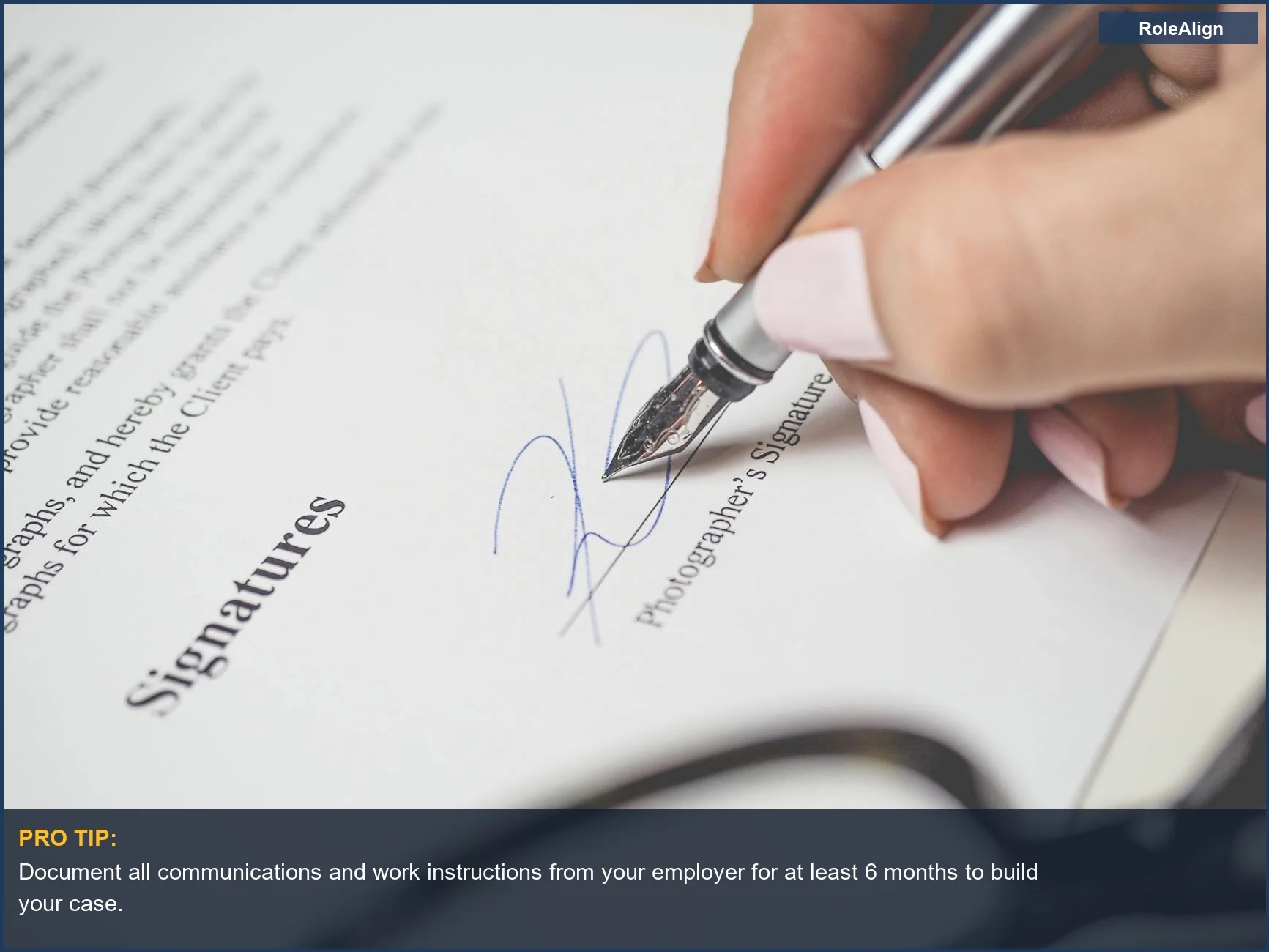
Document all communications and work instructions from your employer for at least 6 months to build your case.
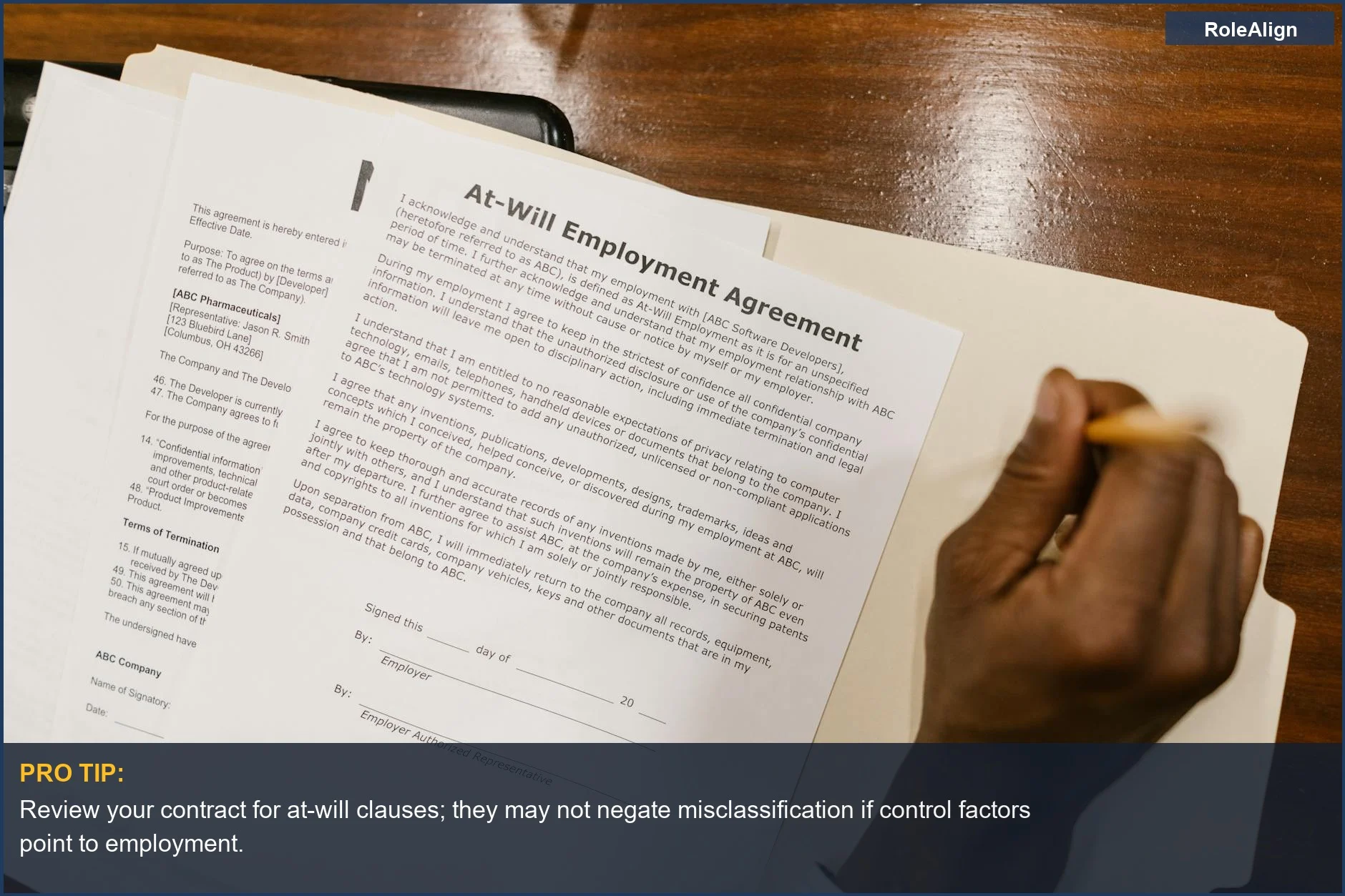
Signing a contract is a critical step, but if your employer is engaged in misclassification, it can lead to significant legal issues. Understand your rights. | Photo by energepic.com

What's Actually Going On

1
Understand the Mechanics - Employers often classify workers as contractors to reduce costs. This can involve avoiding obligations such as providing health insurance, paid time off, and contributions to retirement plans. Large enterprises are less likely to misclassify due to higher scrutiny and penalties than startups, which may operate with fewer resources and less awareness of complex labor laws. The tech industry, in particular, has many contract roles, but the lines can blur for specialized skills where the worker's expertise is paramount. Finance and healthcare regulations often dictate employee classifications due to the sensitive nature of the work and stringent compliance requirements. Senior roles can be particularly nuanced, fitting either category based on the degree of autonomy and control the worker exercises versus the control exerted by the employer. For instance, a senior software engineer who works on a specific, time-bound project with minimal oversight might resemble a contractor, while a senior manager who is deeply integrated into the company's strategic decision-making and subject to its operational procedures is more likely an employee. How Hiring Decisions Are Made - Applicant Tracking Systems (ATS) are sophisticated software tools that flag resumes based on keywords, experience, and other criteria. Recruiters then conduct initial screenings to assess for specific technical skills and cultural fit within the existing team. Ultimately, hiring committees evaluate candidates on their projected value to the company and their potential for seamless team integration. Contract roles, by their nature, often prioritize immediate availability and a very specific set of project-based skills. The National Employment Law Project estimates that a significant percentage, between 10% and 30%, of employers misclassify workers, thereby denying them crucial legal protections and employment benefits. This practice can be driven by a desire to maintain flexibility in staffing or to reduce overhead, but it carries substantial legal risks. The Real-World Impact of Misclassification - Misclassification as an independent contractor often means missing out on fundamental employee benefits and protections. This includes a lack of guaranteed minimum wage, no entitlement to overtime pay for hours worked beyond the standard workweek, and the absence of employer-sponsored health insurance, paid sick leave, vacation time, and retirement contributions like 401(k) matching. The U.S. Department of Labor explicitly states that misclassified employees are denied the protections afforded by the Fair Labor Standards Act (FLSA), which covers minimum wage and overtime. Employers also gain a financial advantage by saving on payroll taxes, such as Social Security and Medicare contributions, which are typically shared between the employer and employee. For 2026, the IRS updated rules for Form 1099-NEC, which is used to report payments to independent contractors, introducing a new threshold of $2,000 for reporting non-employee compensation. This change underscores the IRS's focus on accurate worker classification. Key Factors in Determining Classification - Both the IRS and the Department of Labor employ a multi-factor test to distinguish between employees and independent contractors. These tests primarily focus on three core areas: behavioral control, which examines whether the employer directs and controls how and when the work is done; financial control, which assesses the worker's opportunity for profit or loss, their investment in their own tools or equipment, and how they are paid; and the nature of the relationship between the parties, which considers factors like whether there is a written contract, the permanency of the relationship, and whether the work performed is integral to the employer's core business operations. If your employer dictates your work hours, provides all necessary equipment and supplies, reimburses your business expenses, or if you work exclusively for them without offering services to other clients, you may be misclassified. Consulting with an employment lawyer, such as a Phoenix employment lawyer, can provide expert guidance in assessing your specific situation and understanding your rights. The Financial and Legal Ramifications for Employers - Misclassification carries significant risks and potential financial liabilities for employers. These can include substantial back taxes owed to the IRS and state labor departments, along with considerable penalties and interest on those unpaid taxes. Misclassification can lead to serious tax liabilities and penalties, as employers may be required to pay the employer's share of Social Security and Medicare taxes, unemployment taxes, and other employment-related taxes. The IRS now charges $340 for every missing 1099 form, highlighting the cost of non-compliance. Furthermore, misclassified workers can pursue legal action to recover unpaid overtime wages, benefits they were denied, and other entitlements, leading to costly litigation, potential class-action lawsuits, and significant reputational damage for the employer. This can disrupt business operations and negatively impact future hiring efforts.
Understanding employee expectations also involves recognizing their rights, such as grasping contractual obligations in the workplace.
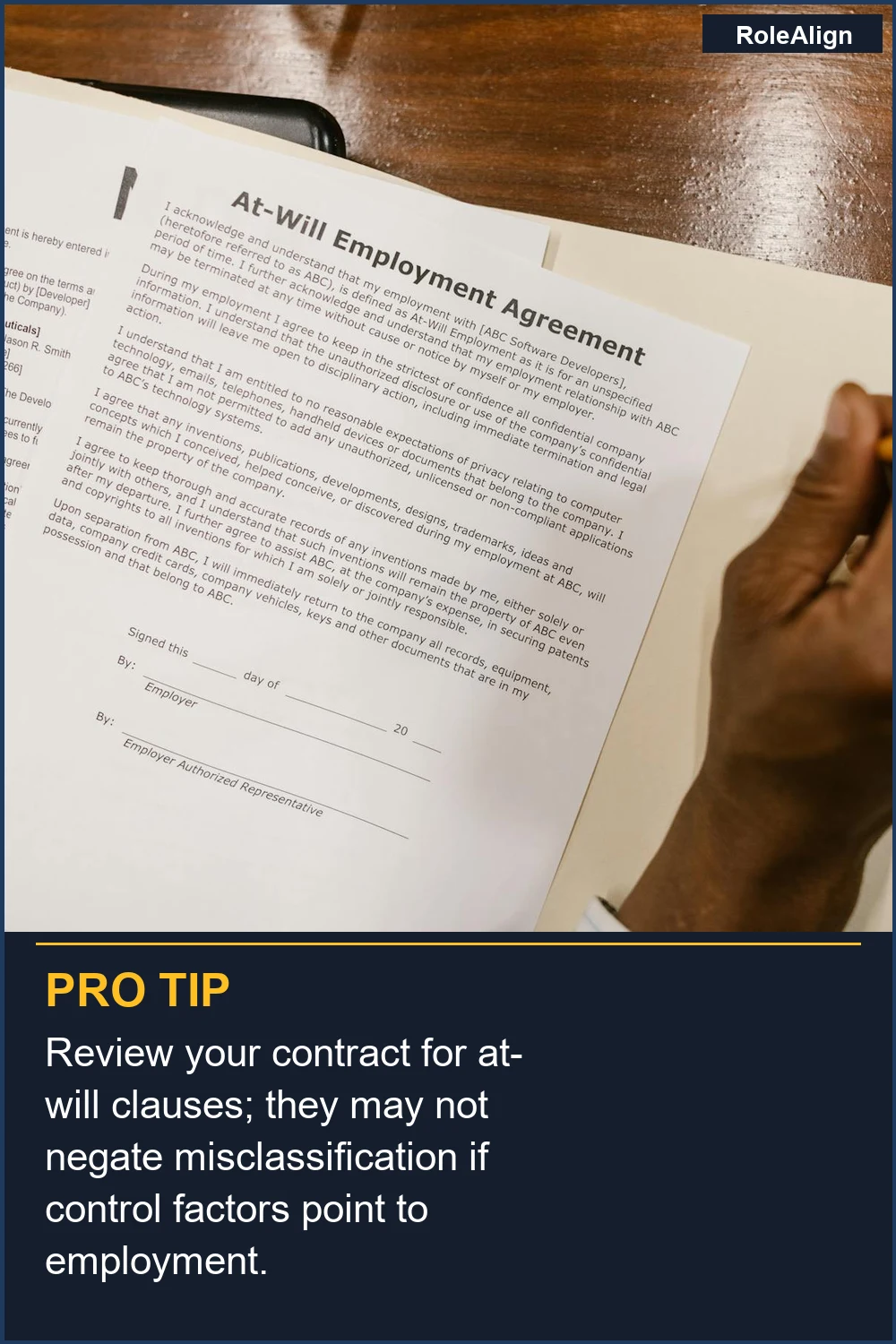
Review your contract for at-will clauses; they may not negate misclassification if control factors point to employment.
An at-will employment agreement is a common document, yet it doesn't automatically mean you aren't a misclassified contractor. Know the difference. | Photo by RDNE Stock project

How to Handle This

1
Confirm classification criteria - Before confronting your employer, verify if you are truly misclassified. Review the IRS guidelines on worker classification, focusing on behavioral control, financial control, and the nature of the relationship. For instance, does your employer dictate how and when you perform your work, provide the necessary tools, or offer benefits typically associated with employees? This initial research is critical; it's the foundation for any claim you might make What Can I Do if I Was Misclassified as an Independent Contractor?. Understanding these distinctions is paramount. The IRS, for example, looks at factors such as whether the worker has the right to control what will be done and how it will be done; the extent to which the worker has unreimbursed business expenses; the degree to which the worker has permanent or temporary arrangements; and the nature of the payment (e.g., by the hour versus by the job). Misclassification of Employees as Independent Contractors Under .... If your employer sets your work hours, requires you to use specific methods or tools, provides training, or integrates your services into their core business operations, you are likely an employee, not an independent contractor.
2
Document everything meticulously - Start a detailed log of your workdays, hours, tasks, communications with your employer, and any expenses you incur. This documentation is your primary evidence. This raw data demonstrates the reality of your role versus the contractual label. If you don't document, you lose the ability to prove the extent of your employer's control and the actual nature of your work, making it impossible to substantiate a claim of being a misclassified contractor. Keep copies of any contracts, invoices, pay stubs, emails, performance reviews, and any other relevant correspondence. Note down specific instances where your employer exerted control over your work, such as dictating your schedule, requiring you to attend mandatory meetings, or restricting your ability to work for other clients. This comprehensive record-keeping is vital for building a strong case and can include details about your autonomy, ability to set your own hours, and whether you provided your own equipment.
3
Initiate a formal, written request - Draft a professional letter or email to your employer outlining your concerns about your classification. Clearly state why you believe you are an employee based on the work performed and the control exerted. For senior-level or highly specialized roles, this communication should be factual and business-oriented. Failing to do this can make you appear unreasonable if the issue escalates and misses an opportunity to prompt a reclassification or at least an explanation from the employer Misclassified by an Employer - What You Can Do. Frame your request politely but firmly, referencing the specific IRS or DOL criteria that suggest an employer-employee relationship. For example, you might state, "Based on the level of control exercised over my daily tasks and work schedule, and the provision of essential tools and training, I believe my classification as an independent contractor may be incorrect according to federal and state labor laws." This written record serves as proof of your attempt to resolve the issue internally. What to Do if You're Being Misclassified by Your Employer.
4
Consult with an employment attorney - If your employer is unresponsive or dismissive, seek legal counsel immediately. An attorney specializing in employment law can assess your case, advise on the best course of action, and represent you in negotiations or legal proceedings. This is especially critical given the potential for significant financial ramifications, including back pay, overtime, and benefits What to Do if You are Misclassified as an Independent Contractor?. They can help you understand your rights and the potential outcomes, such as recovering unpaid minimum wage, overtime, and other employee benefits you may have been denied Independent contractor misclassification: 2026 guide & best practices. An attorney can also guide you on whether to file a complaint with the Department of Labor or pursue legal action.
Understanding your employment status can also shed light on situations like wrongful termination claims.
Consult with an employment lawyer specializing in worker classification for expert advice within 30 days of suspicion.
Business professionals signing a legal contract often signifies formal agreements, but it's crucial to ensure the classification is accurate to avoid employer misclassification. | Photo by RDNE Stock project

What This Looks Like in Practice

  • Senior Software Engineer at a Series B Startup: Hired to build core features for a new product, this engineer was provided equipment, given a strict schedule, and dictated how tasks were completed, functioning as a regular employee. The company classified the role as a contractor to avoid payroll taxes and benefits. The engineer discovered this misclassification due to a lack of employee benefits and protections. After consulting an employment attorney and initiating a claim, a settlement for back pay and benefits was reached. This highlights how a lack of behavioral control and financial control by the worker, coupled with significant employer direction, indicates an employee relationship What Can I Do if I Was Misclassified as an Independent Contractor?.
  • Entry-Level Data Analyst at a Large Corporation: This analyst supported a major data migration project, working within a dedicated team, using company tools, and having work hours and performance expectations set by the company, integrating them like other employees. Despite this clear employer-employee dynamic, the role was classified as an independent contractor. An internal audit revealed the misclassification, prompting the company to reclassify the position and provide back pay and benefits. This scenario underscores that for entry-level roles, employer control over the work indicates employee status Misclassification of Employees as Independent Contractors Under ....
  • Career Changer from Teaching to Product Management at a Mid-Size Tech Firm: Hired to manage a new product launch, this individual reported to a VP, attended company-wide meetings, used company equipment, and adhered to company policies and timelines. The firm classified them as a contractor, saving on employer-side taxes. When the project concluded, the individual was let go without severance, prompting an investigation into their rights. An employment lawyer advised that the integration into the business and employer control indicated employee status, leading to a successful claim for wrongful termination and unpaid benefits. An estimated 10% to 30% of employers misclassify their workers Independent contractor misclassification: 2026 guide & best practices.

Understanding your rights can also help you navigate tricky questions during hiring, like those covered in what employers cannot ask.
Organize with at least 3 other affected colleagues to strengthen your collective bargaining power for fair classification.
Protesting workers highlight the real-world impact of employer misclassification. Many employees are denied benefits and fair treatment when wrongly classified. | Photo by DaddyAI

Mistakes That Kill Your Chances

Mistake Believing contract terms automatically dictate classification.
Why candidates make it New grads or those new to contracting assume the paperwork is final, focusing on the "independent contractor" label without scrutinizing the working relationship.
What recruiters actually see Recruiters know the *actual working relationship* is paramount. Courts and agencies look beyond the contract to factors like control over work, integration into the business, and financial independence to determine true contractor status. A contract alone is weak defense.
The fix Thoroughly review your day-to-day responsibilities against IRS behavioral and financial control tests, and the ABC test. Understand the substance of your role, not just the title. Focus on employer control over your work.
Mistake Assuming higher pay means contractor status.
Why candidates make it Intuition suggests contractors earn more due to self-funded taxes and benefits, leading to the belief that a higher rate is a definitive sign.
What recruiters actually see Higher compensation can be a factor, but not a sole determinant. Recruiters know employers may offer a higher rate to avoid employee benefits and taxes, a cost-saving measure. The economic reality test matters most.
Fix Analyze the total compensation package, including the absence of benefits like health insurance, paid time off, and retirement contributions. If the higher rate barely covers these expenses, it weakens the contractor argument. Misclassification can lead to substantial penalties for the employer.
Mistake Waiting too long to address misclassification, especially mid-career.
Why candidates make it Mid-career professionals may prioritize stability and fear challenging their employer, rationalizing the situation as temporary or not worth the hassle.
What recruiters actually see Recruiters understand that prolonged misclassification increases employer liability. However, delaying action by the worker can weaken their claim, suggesting acceptance. Early action is crucial.
Fix If you suspect misclassification mid-career, document everything immediately. Make a written request to your employer for classification clarification. Don't let years pass without addressing it.
Mistake Assuming the $600 threshold for 1099 forms means you're a contractor if paid less.
Why candidates make it Many incorrectly believe payments below the $600 1099 threshold automatically confirm independent contractor status.
What recruiters actually see Recruiters know the $600 threshold (now $2,000 for payments made in 2026) is an IRS reporting requirement, not a legal definition. Employers can misclassify someone without issuing a 1099.
Fix Understand the 1099 form is for reporting income, not legal classification. Focus on factors determining employee status, such as behavioral control and financial independence, regardless of payment amounts. Failing this check leads to expensive back taxes.
Navigating job offers can be tricky, especially if you find yourself overqualified for a position.
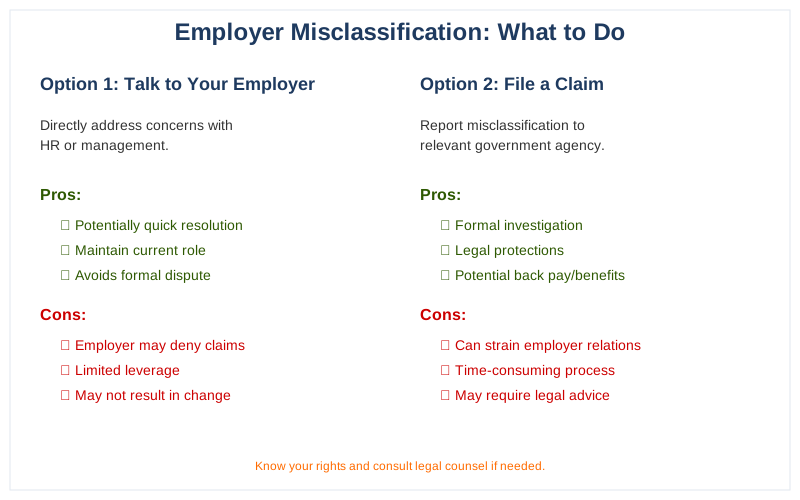
Infographic comparing employer misclassification pros/cons.
Product comparison for What to Do If Your Employer Misclassifies You as a Contractor

Key Takeaways

  • Confirm your classification by reviewing your work arrangement and tasks. Employers must correctly classify workers, as misclassification can lead to workers being denied minimum wage, overtime pay, and other essential protections Misclassification of Employees as Independent Contractors Under .... This often involves examining the degree of control the employer has over the work performed, the worker's opportunity for profit or loss, and the permanency of the relationship. For example, if your employer dictates your hours, provides the tools you use, and integrates your work into their core business, you might be an employee.
  • If you believe you are a misclassified contractor, consider a direct conversation with your employer. Sometimes, misclassification is an honest mistake, and a clear discussion can resolve the issue What to Do if You're Being Misclassified by Your Employer. Present your concerns calmly and reference specific aspects of your work that align with employee status.
  • Understand that the determination of employee vs. contractor is fact-specific, often involving tests for behavioral control, financial control, and the nature of the relationship houklawfirm.com. These tests aim to discern whether the worker is truly operating an independent business or is economically dependent on the employer.
  • Be aware that misclassification can result in significant penalties for employers, including back taxes and fines 1099 Form Guide 2026: Avoid Worker Misclassification | DianaHR. This includes potential liability for unpaid overtime, minimum wage, Social Security, Medicare, and unemployment taxes.
  • The single most important thing a recruiter would tell you off the record? Document everything. Your contract, emails, work instructions, and any evidence of control your employer exerts are your strongest allies if you need to prove you were an employee all along Independent contractor misclassification: 2026 guide & best practices. Keep records of your work schedule, communications with your supervisor, and any expenses you incur that are typically covered by an employer for their employees. If a direct conversation doesn't resolve the issue, consulting with an employment attorney is a crucial next step What to Do if You are Misclassified as an Independent Contractor.

Understanding your classification can help you navigate potential issues, including pitfalls like non-compete clauses.

Frequently Asked Questions

My employer is treating me like an employee, but paying me as a contractor. What should I do?
If you believe your employer has misclassified you as a contractor when you should be an employee, the first step is to review your work arrangement and tasks to confirm your classification. Sometimes, misclassification is an honest mistake, so discussing it with your employer directly, perhaps with a written request for clarification, can be a good starting point. If that doesn't resolve the issue, you may need to seek legal advice.
What are the potential downsides if I'm misclassified as an independent contractor?
Being misclassified as an independent contractor can significantly impact your wages, taxes, and benefits. You might be denied minimum wage and overtime pay protections under laws like the Fair Labor Standards Act (FLSA). Additionally, you could miss out on important benefits like unemployment insurance, workers' compensation, and employer-sponsored health insurance.
How can I tell if I'm actually an employee and not an independent contractor?
The key difference often lies in the level of control. If your employer has the right to control or direct how and when you perform your work, and you use their equipment, you're likely an employee. Independent contractors typically have more freedom to set their own hours, work for multiple clients, and are paid for the outcome of their work rather than by the hour.
If I was misclassified, can I recover lost wages or benefits?
Yes, if you were misclassified as an independent contractor, you may be entitled to recover lost wages, including minimum wage and overtime pay, as well as other benefits you would have received as an employee. It's advisable to consult with an employment attorney who can assess your specific situation and guide you through the process of seeking recourse.
Should I contact a lawyer if I suspect my employer misclassified me?
Yes, contacting a knowledgeable employment attorney is highly recommended if you suspect misclassification. They can help you understand your rights, gather evidence, and explore your options, which might include filing a claim with government agencies or pursuing legal action. Many attorneys offer initial consultations to assess your case.
Are there specific government agencies I can report misclassification to?
You can report potential worker misclassification to agencies like the U.S. Department of Labor (DOL) or your state's Department of Labor and Industry. These agencies investigate violations of labor laws and can help ensure workers receive the protections and benefits they are entitled to.

Sources

Related Articles