
Strategies for Continuous Learning and Upskilling in AI (2026 Complete Guide)
I remember spending 43 minutes last week debugging a TensorFlow model that was failing due to a simple data type mismatch, not some complex algorithmic issue. This is the unglamorous part of AI that LinkedIn posts never show you. Everyone's talking about AI transforming jobs, and they're not wrong.
I remember spending 43 minutes last week debugging a TensorFlow model that was failing due to a simple data type mismatch, not some complex algorithmic issue. This is the unglamorous part of AI that LinkedIn posts never show you. Everyone's talking about AI transforming jobs, and they're not wrong. The World Economic Forum says 80 percent of the global workforce needs to acquire new skills by 2027 to stay competitive.
That's not a soft suggestion; it's a hard deadline for most of us. Digital Applied's workforce guide makes it clear: the clock is ticking.
But here's what the LinkedIn gurus won't tell you: 'upskilling in AI' isn't about becoming a prompt engineer overnight. It's about understanding the operational reality of how AI gets built, deployed, and maintained. It's about the SQL queries, the Git conflicts, and the endless meetings explaining why your model isn't magic.
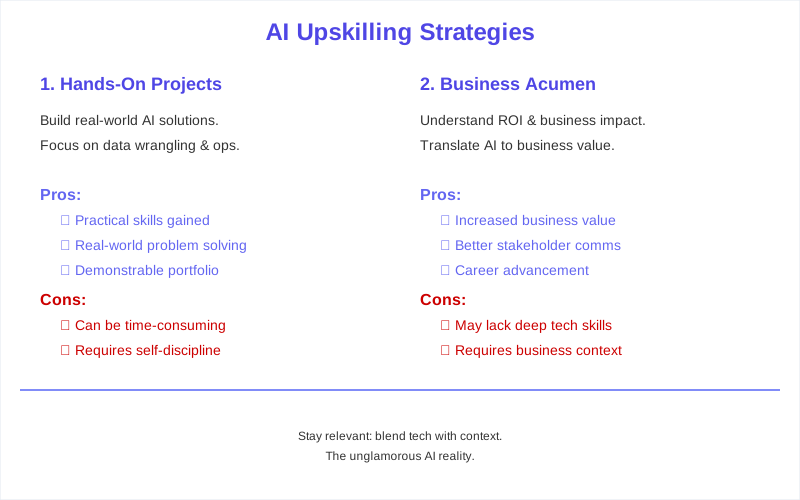
I've seen too many people chase the hype, spending thousands on certifications that teach theory but zero practical application. The actual job involves far more data wrangling and stakeholder management than it does optimizing neural networks. Learning Python and machine learning is like learning to drive; it doesn't mean you know how to build a car or run a trucking company.
The future of AI skills, according to Arisa's 2026 outlook, isn't just about technical prowess. It's about blending that with a deep understanding of business context and communication. If you can't translate your F1 score into ROI for a VP, your brilliant model is just a fancy Python script collecting dust.
This isn't about fear-mongering; it's about giving you the signal vs hype. I'll break down what continuous learning and upskilling in AI actually looks like, what the real requirements are, and how to navigate the pivot tax without getting ripped off by every bootcamp promising a '$200K salary in 12 weeks.'
The Real Answer
The real answer to staying relevant in AI isn't about memorizing the latest library or chasing every new LLM. It's about understanding that AI is a product, and products need to deliver business value. My mental model for continuous learning is simple: focus on the full lifecycle, not just the modeling part. Absorb LMS emphasizes recognizing the strategic importance of upskilling.
Most people think 'AI skills' means coding. The actual job demands you understand the entire pipeline: data ingestion, cleaning, feature engineering, model training, deployment, monitoring, and maintenance. If your model isn't in production and providing measurable impact, it's a science fair project.
This means your learning needs to span beyond just algorithms. You need to grasp cloud infrastructure (AWS, GCP, Azure), MLOps tools (Kubeflow, MLflow), and robust data engineering principles. The model is only as good as the data it eats and the infrastructure it runs on.
I've seen projects with cutting-edge models fall flat because the data quality was garbage, or the deployment process was a nightmare. No amount of fancy deep learning can fix a fundamentally broken data pipeline. That's the unglamorous 80 percent of the work.
Upskilling is a change imperative, not just a nice-to-have. McKinsey highlights that leadership needs to tell the change story, not just throw tools at employees. You need to understand how your work fits into the larger organizational goals, not just your specific task.
Your ability to communicate technical concepts to non-technical stakeholders is often more valuable than your ability to implement a custom attention mechanism. I've seen brilliant engineers stagnate because they couldn't translate ROC curves into a clear business recommendation.


What's Actually Going On
What's actually going on in the market is a fundamental shift in job responsibilities, not just a new set of tools. Approximately 1 in 10 job postings now explicitly require AI skills, a figure that has tripled since 2023. But the hidden demand is even larger, with many roles implicitly requiring AI competency according to Digital Applied. This isn't just for ML Engineers; it's for marketing managers, financial analysts, and even HR.
Recruiters are increasingly using AI-powered ATS (Applicant Tracking Systems) that scan for specific keywords. If your resume doesn't hit those, it's getting filtered out before a human even sees it. This means your learning needs to be targeted, not just broad.
Company size matters, too. At a startup, you'll be a generalist, touching everything from data engineering to model deployment. At a large enterprise, you'll likely specialize, focusing on a specific part of the AI lifecycle. Your upskilling path needs to reflect this reality.
Regulatory facts are also coming into play. With AI governance and ethics becoming more prominent, understanding concepts like fairness, explainability, and privacy isn't just academic; it's a job requirement. I've been in meetings where legal teams scrutinize model decisions, and if you can't explain why your model did what it did, you're in trouble.
Forbes emphasizes starting with transparency and trust, and positioning upskilling as a growth pathway in their business council tips. This means companies are looking for people who not only have the skills but also understand the implications of using AI.
The industry is also seeing a push for diversification of skill sets. Cross-training initiatives, where employees learn skills beyond their primary role, are becoming more common to foster innovation and adaptability, as Learnt.AI explains. This means a narrow focus on just one AI sub-field might limit your long-term growth.
How to Handle This
First, assess your current AI readiness. Don't just guess; map your existing skills against job descriptions for the roles you want. Corporate Training 360 suggests this as the initial step for building an AI upskilling strategy.
Next, define role-specific AI competencies. If you're a marketing analyst, focus on AI tools for campaign optimization and prompt engineering. If you're a software engineer, dive into MLOps and cloud deployment. Don't waste time learning deep reinforcement learning if your job involves SQL and Tableau.
Choose your learning channels wisely. For foundational knowledge, fast.AI and Andrew Ng's courses on Coursera are solid, low-cost options. For hands-on experience, Kaggle competitions and personal projects with real-world datasets are invaluable. I spent 3 months on fast.AI before even touching a job application.
Time management is critical. Dedicate at least 5-10 hours a week, consistently. This isn't a sprint; it's a marathon. Block off specific times in your calendar and treat them like non-negotiable meetings. The pivot tax requires commitment.
Build a portfolio project that actually works on real data. This is what sets you apart. A simple Flask app with a deployed model on Heroku or AWS Lambda speaks volumes more than a dozen certificates. Make it something a recruiter can actually click and interact with.
Finally, network with people actually working in AI. Go to local meetups, connect on LinkedIn, and ask specific, informed questions. Don't just ask for a job; ask about their day-to-day, the tools they use, and the biggest challenges they face. HBR emphasizes that reskilling requires new paradigms for leaders and employees, meaning you need to be proactive.
Consider a targeted bootcamp for specific skills, but be highly skeptical of their placement promises. Look for programs with strong alumni networks and verifiable project outcomes, not just flashy marketing. Expect to pay $5,000-$15,000 for a decent one, and view it as an investment, not a guaranteed golden ticket.

What This Looks Like in Practice
In a mid-sized e-commerce company, an existing data analyst upskilled by focusing on SQL for feature engineering and basic Python for model inference. After 6 months, their team saw a 15 percent increase in targeted ad campaign ROI because their models were finally getting clean, relevant features. TDS Personnel highlights that foundational AI literacy and focusing on impact are key.
At a large financial institution, a senior software engineer pivoted to an MLOps role. They spent 9 months learning Docker, Kubernetes, and AWS SageMaker. Their first big win was reducing model deployment time from 3 weeks to 2 days, cutting operational overhead by 70 percent. This wasn't about building a new model, but making existing ones work reliably.
For a marketing manager, upskilling meant mastering prompt engineering for generative AI tools like ChatGPT and Midjourney. They reduced content creation time by 40 percent and increased engagement on social media campaigns by 25 percent within a year. They didn't write a single line of Python, but they understood how to leverage AI effectively.
In a manufacturing company, a process engineer learned to interpret sensor data using basic time-series analysis in Python. Their new insights helped reduce equipment downtime by 12 percent, saving the company hundreds of thousands annually. They weren't building complex deep learning models, just applying fundamental data science to a real problem.
These scenarios show that upskilling isn't always about becoming a 'data scientist.' It's about applying AI literacy and tools to solve concrete business problems, driving measurable metrics, and focusing on human judgment. Berkeley CMR emphasizes rethinking AI adoption through resilience and accountability.

Mistakes That Kill Your Chances
| Mistake | Why it Kills Your Chances | The Operational Reality |
|---|---|---|
| Chasing every new framework | You become a jack of all trades, master of none. Recruiters look for depth. | The actual job requires you to deeply understand one or two frameworks, not superficially touch ten. |
| Focusing only on algorithms | Ignores the 80 percent of the job that is data and infrastructure. | You'll spend more time debugging SQL queries than optimizing a neural net. |
| Ignoring communication skills | Cannot translate technical work into business value, leading to project stagnation. | I've seen brilliant researchers fail because they couldn't explain F1 scores to a VP. |
| Not building a portfolio | Certificates don't prove you can *do* the work. | Your GitHub repo and deployed projects are your real resume. |
| Expecting instant results | The pivot tax is real; it takes time and sustained effort. | Bootcamp ads promising '$200K salaries in 12 weeks' are selling a fantasy. |
| Learning in isolation | Misses out on real-world context, feedback, and networking opportunities. | You need to talk to people who actually do the job, not just read blogs. |
| Neglecting MLOps | Your models will never make it to production or will fail spectacularly. | Production does not care about your Jupyter notebook. Brij Pandey's roadmap emphasizes AI as a full engineering discipline. |
- Focus on the full stack: Don't just learn models; understand data engineering, MLOps, and cloud deployment.
- Prioritize communication: Your ability to explain AI's impact to non-technical stakeholders is crucial for career advancement.
- Build real projects: A deployed, working project is worth more than a dozen certifications.
- Manage expectations: Upskilling takes time, effort, and often a temporary pay cut.
- Stay practical: What are the unglamorous 80 percent of the tasks? Master those.
Frequently Asked Questions
Should I pay $500 for a 'Prompt Engineering Masterclass' or just practice with ChatGPT?
Do I really need to understand Docker for an entry-level ML role?
What if I spend months learning and still can't land an AI job?
Can focusing too much on niche AI areas like reinforcement learning permanently hurt my career prospects if demand shifts?
Is it true that AI will automate all the data cleaning and feature engineering soon, making those skills obsolete?
Sources
- Upskilling is the key to success in 2026 – Here's 10 ways to prepare
- Upskilling to Accountability: Rethinking AI Adoption Through ...
- How to Master AI in 2026 (The Only Roadmap That Matters) - LinkedIn
- Strategies for Encouraging Continuous Learning and Up-skilling in ...
- Redefine AI upskilling as a change imperative | McKinsey & Company
- AI Upskilling 2026: Stay Relevant as 80% Must Retrain
- AI Upskilling Programs: The Complete Guide for 2026
- Five Ways to Upskill in 2026 for Success in an AI-Driven Market
- How to Learn AI and Deep Learning in 2026: Skills, Tools, and ...
- 17 Tips For Building Strong Workforce Development In The AI Age
- Reskilling in the Age of AI
- The future of AI skills: what to learn in 2026 - Arisa