
How to Answer Why Are You Leaving Your Current Job (2026 Complete Guide)
You're staring at your laptop screen, the rejection email from your dream job still stinging. Or maybe you're prepping for a crucial interview tomorrow, the "why are you leaving your current job" question looming. This is the moment where your carefully crafted resume meets the unpredictable reality of human interaction.
You're staring at your laptop screen, the rejection email from your dream job still stinging. Or maybe you're prepping for a crucial interview tomorrow, the "why are you leaving your current job" question looming. This is the moment where your carefully crafted resume meets the unpredictable reality of human interaction. Hiring managers aren't just looking for skills; they're assessing your professionalism and your forward momentum. They want to understand what truly motivates you and what kind of environment will foster your engagement. As Hays points out, your answer carries significant weight because it offers clues about your long-term goals and the company culture that might best suit you. The key is to pivot from what you're leaving behind to what you're moving towards. Instead of dwelling on negatives, frame your departure as a strategic step for growth and new opportunities. This interview question isn't about airing grievances; it's your chance to demonstrate clarity, ambition, and a proactive approach to your career path. Michael Page emphasizes that a well-planned, positive response can highlight your suitability for the new role, shifting the focus to the positives of the position you've applied for. For instance, instead of saying "I'm bored," you can articulate a desire for "greater challenges and opportunities for professional development," as suggested by Robert Walters. Similarly, if your current role lacks advancement, you can express that you are "seeking an opportunity to take on more responsibility and foster further career growth," a sentiment often met positively according to discussions on Reddit. Even if external factors like company restructuring or mergers are at play, as noted by SNHU, framing it as a "desire for a more stable and forward-looking environment" can be effective. Ultimately, your answer should convey that you are actively pursuing a role that aligns with your aspirations and offers the potential for mutual benefit, rather than simply escaping an undesirable situation. This proactive stance demonstrates maturity and a clear understanding of your career trajectory.
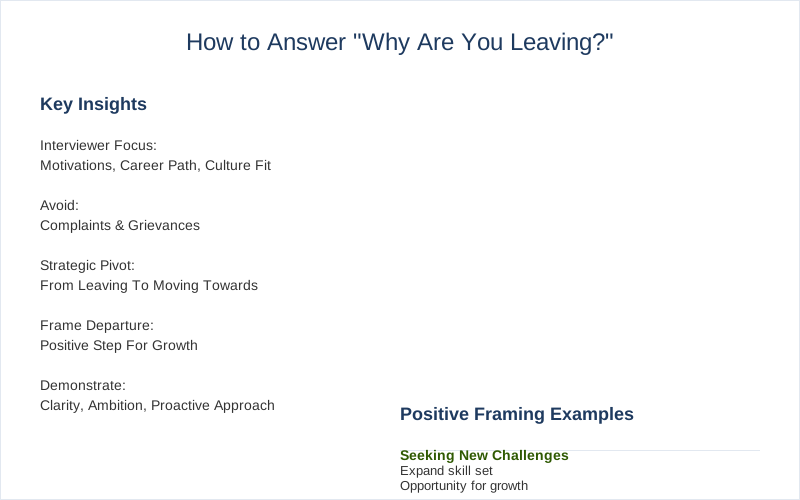
Interviewers ask "why are you leaving your current job" not to hear complaints, but to understand your motivations, career trajectory, and cultural fit.
Forget rehashing grievances. Recruiters are scanning for red flags, not validating your frustrations. Your answer is a strategic opportunity to pivot from what you're leaving to what you're moving towards.
The core insight is this: frame your departure as a positive step forward, driven by a desire for growth, new challenges, or a better alignment with your career goals. Instead of focusing on the negatives of your past role, emphasize the opportunities the new role presents. This shows you are proactive and forward-thinking.
Good reasons for leaving a job often center on career advancement or a desire for new challenges Robert Walters. You might be seeking opportunities for greater responsibility or a chance to expand your skill set in a new environment Michael Page. This demonstrates ambition and a clear vision for your professional development. Many candidates find that articulating a desire for more responsibility or growth is consistently met with positive reception Reddit.
Consider reasons like:
- You are ready to grow professionally and take on more responsibility SNHU. This could involve managing a larger team, leading more complex projects, or developing new strategic initiatives.
- You are looking for an opportunity for career advancement or a new challenge Robert Half. Perhaps your current role has plateaued, and you are seeking a position with more upward mobility or a chance to tackle a different type of problem.
- You want to change industries or functions, leveraging your existing skills in a new context. For instance, a marketing professional might want to move into a more data-analytics-focused role within the tech industry.
- You are seeking greater work flexibility or work-life balance MasterClass. This is a valid and increasingly common reason, especially in today's evolving work landscape.
- Company changes such as a downturn, acquisition, merger, or restructuring can also be legitimate reasons for seeking new employment SNHU.
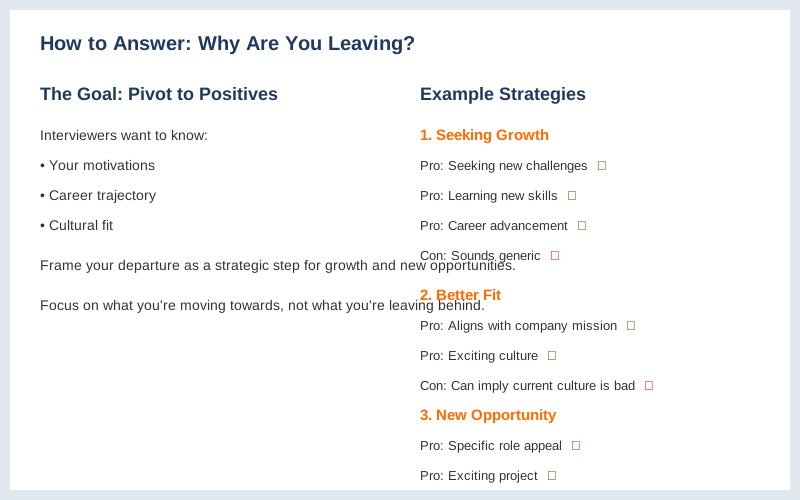
Avoid any answer that sounds like you are running away from something; instead, articulate why you are running towards this specific opportunity. Tailor your response to highlight how your aspirations align with the company's mission and the role's requirements. For example, instead of saying "I'm bored," you could say, "I'm eager to apply my skills in a more dynamic environment where I can contribute to innovative projects like the ones your company is undertaking." This demonstrates enthusiasm and a genuine interest in the prospective employer.






- Seeking Growth and New Challenges: This is a universally positive reason. Frame it around outgrowing your current role and actively seeking opportunities to expand your skill set and take on more responsibility that aligns with the target job. For instance, a "Senior Software Engineer at a Series B Startup" might say they've mastered the current tech stack but are eager to tackle the complexities of larger-scale system design required in a more established company. This resonates with employers wanting ambitious individuals Robert Walters.
- Career Advancement and Development: This is a strong motivator for many professionals. An "Entry-Level Data Analyst at a Fortune 500" could explain that while they've learned foundational skills, they're ready for a role with more direct impact on strategic decisions and opportunities to specialize in areas like ML or advanced AI modeling. This shows a clear career trajectory and a desire to contribute more significantly Michael Page.
- Desire for a Different Industry or Role Type: For a "Career Changer from Teaching to Product Management," the narrative is about leveraging transferable skills. They might explain that after years of curriculum development and stakeholder management, they are now seeking to apply those organizational and strategic planning abilities in a product-focused environment, particularly one leveraging educational technology. This signals a deliberate and well-thought-out pivot Robert Half.
- Company Restructuring or Reorganization: If your current company is undergoing changes like mergers, acquisitions, or significant layoffs, this is a legitimate and often unavoidable reason for leaving. A "Mid-Level Marketing Manager at a company acquired by a larger competitor" could state that the integration process has led to role redundancies or a shift in strategic direction that no longer aligns with their career goals. This avoids any negative reflection on your performance SNHU.
- The single most important thing a recruiter will tell you off the record is this: they are looking for reasons *not* to hire you. Your answer to "why are you leaving your current job" is your chance to proactively defuse those potential red flags. Frame your departure around future opportunities and growth, never past negatives.
- You are looking for career advancement and new challenges 5 Strategic Reasons for Leaving a Job: How to Answer This .... This is a universally positive reason that signals ambition and a desire to contribute more.
- You want to change industries or roles 15 Best Reasons for Leaving a Job (With Examples) - Robert Walters. This shows you've thought strategically about your career path and are seeking a deliberate shift.
- You're seeking greater work flexibility or work-life balance How to Answer 'Why Are You Leaving Your Current Job?' - 2026. This addresses a common need and can be framed as optimizing your productivity.
- Your current role has become stagnant, and you desire new responsibilities or a bigger challenge How to answer the "why are you leaving your current jobs" question .... This highlights your readiness for the next step and your proactive pursuit of development.
Frequently Asked Questions
What's a good way to explain I'm leaving my current job because I want to grow?
How should I answer if I'm leaving because the company is restructuring?
My current job doesn't offer work-life balance. How do I say that professionally?
What's the best way to say I want to change industries?
I feel like I've hit a ceiling at my current job. What should I say?
What if I'm leaving because I want to be closer to home?
How do I explain I'm leaving for a better opportunity without sounding negative?
Sources
- 15 Best Reasons for Leaving a Job (With Examples) - Robert Walters
- Why do you want to leave your current job - Hays
- How to Answer 'Why Are You Leaving Your Current Job?' - 2026
- 11 Good Reasons for Leaving a Job - SNHU
- how-to-explain-reasons-for-leaving-a-job
- 5 Strategic Reasons for Leaving a Job: How to Answer This ...
- Explaining the reason for leaving your current job - Michael Page
- How to answer the "why are you leaving your current jobs" question ...