
Why Job Descriptions Are Misleading and What to Read Instead (Recruiter Breakdown)
You've just scrolled past another job posting, the requirements a mile long, demanding a unicorn. It's a familiar feeling, right? You're staring at that screen, wondering why job descriptions are so inaccurate and if anyone actually *has* all those listed skills.
You've just scrolled past another job posting, the requirements a mile long, demanding a unicorn. It's a familiar feeling, right? You're staring at that screen, wondering why job descriptions are so inaccurate and if anyone actually has all those listed skills. The reality is, most job descriptions are committee-written wish lists, not accurate reflections of actual needs. Hiring managers, often partnering with HR, draft these in partnership with an HR partner, not recruiters, and the result is often a bloated document. This "skills inflation" means years of experience requirements get inflated, turning what might be a manageable role into an impossible hurdle. The problem is, these descriptions are used to drive key hiring steps candidate profiling, job postings etc., leading to a significant communication gap: while 72% of hiring managers believe they provide clear job descriptions, only 36% of candidates agree in today's rapidly evolving job market, clearly defining job duties and responsibilities is more crucial than ever. You're left sifting through fluff, trying to decipher what's truly required versus what's just nice-to-have. This phenomenon often stems from multiple stakeholders contributing their ideal candidate profile, rather than focusing on the essential functions of the role. For instance, a hiring manager might list every single tool they've ever used, even if only one or two are critical for day-to-day operations. Similarly, HR might add generic "soft skills" that are expected of any professional, regardless of the specific job. The pressure to find the "perfect" candidate can also lead to over-specification, with inflated experience requirements serving as an unintentional barrier to entry. It's a common scenario where a role requiring 3-5 years of experience might be listed with 7-10 years, simply to cast a wider, albeit less effective, net. This disconnect is amplified by the fact that, in today's rapidly evolving job market, clearly defining job duties and responsibilities is more crucial than ever, yet often falls by the wayside in favor of exhaustive, and often unrealistic, checklists.
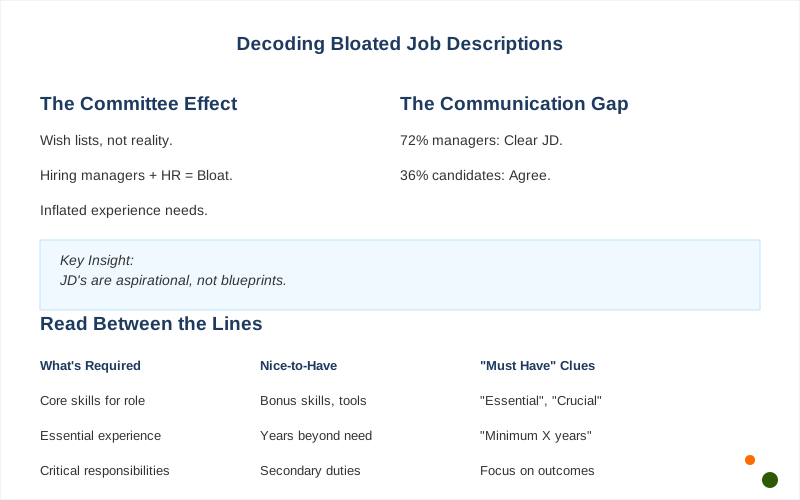
Job descriptions are rarely a precise blueprint of a role; they're aspirational documents, often inflated by committee, designed to attract a broad pool while hedging against future unknowns.
Job descriptions aren't typically written by a single person with a clear vision. Instead, they're a collaborative effort between hiring managers and HR partners (Reddit). This means the final document is a compromise, reflecting the wishes of multiple stakeholders-a "wish list" often including nice-to-have skills rather than strictly required ones. This is why job descriptions become bloated and include seemingly impossible requirements.
The inflation of "years of experience" is common. Companies might list "several years of experience" to signal seniority or attract candidates with a significant track record. This isn't always a hard requirement; it's a signal. If a description lists numerous programming languages but the core function only requires a few, the others are likely there to cast a wider net or cover potential future needs.
What's actually required versus preferred is often obscured. Recruiters and hiring managers use these descriptions to screen candidates, knowing most applicants won't meet every criterion. The goal is to find candidates with core competencies and a willingness to learn. A well-structured job posting should outline sought-after qualifications and skills, alongside benefits and opportunities (UW-Madison HR). Remember, only 36% of candidates agree job descriptions are clear, while 72% of hiring managers believe they are (Talroo), highlighting a significant communication gap.
To read between the lines, focus on the primary responsibilities and essential skills mentioned early in the description. These indicate what the role truly entails. The rest is often a buffet of desired attributes. Look for keywords related to the core function, and don't be discouraged by a lengthy list of "nice-to-haves." Employers often revise job descriptions to attract qualified candidates, suggesting the initial version isn't always the final word (HR Morning).





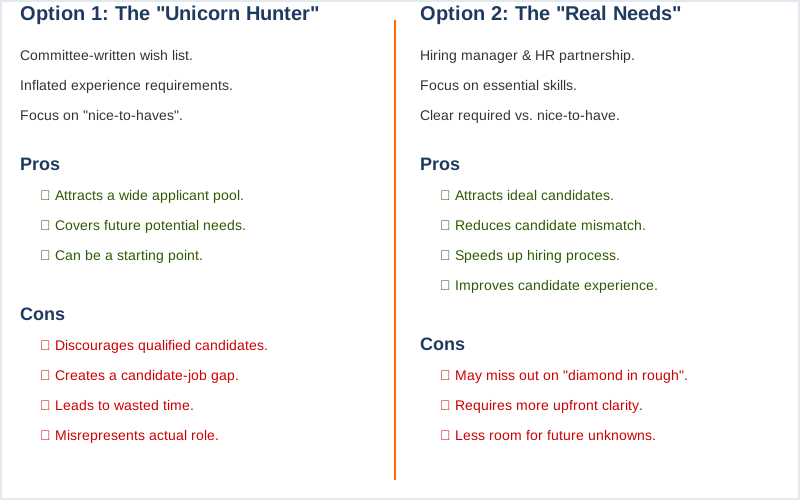
- The "Unicorn" Hunt: Hiring managers often build a list of ideal qualifications that reads like a wish list, demanding a laundry list of skills, technologies, and years of experience that few candidates could realistically possess. This is particularly true in fast-paced startup environments where roles are still being defined. For instance, a Senior Software Engineer role might demand expertise in a dozen niche libraries, experience with a specific cloud provider's entire ecosystem, and a minimum of 7 years of experience, even for a company that's only been operating for 5 years. This inflated requirement list, often crafted in partnership with HR but driven by the manager's vision, means many qualified candidates self-select out because they don't tick every single box Pace Staffing.
- "Required" vs. "Nice-to-Have" Blur: Job descriptions frequently fail to distinguish between absolute necessities and desirable, but non-essential, qualifications. A common scenario is an entry-level Data Analyst role at a large corporation listing advanced statistical modeling, experience with BI tools like Tableau and Power BI, and proficiency in Python and R as "required." In reality, the critical need is for someone who can clean and analyze data in Excel and has a foundational understanding of statistical concepts. The extensive list often reflects the hiring manager's ideal candidate rather than the actual day-to-day needs of the role HR Morning. This discrepancy is a major reason why only 36% of candidates feel job descriptions are clear, while 72% of hiring managers believe they provide clarity Talroo.
- The "Years of Experience" Inflation Game: Companies often inflate the required years of experience for a role, especially in competitive fields like product management. A "Product Manager" role, for example, might ask for 5-7 years of experience, even if the core responsibilities are manageable for someone with 2-3 years of dedicated product management experience, perhaps with additional background in a related field. This inflation serves as a psychological filter, making the role appear more senior or exclusive than it might be. It's a way to manage the candidate pool, but it inadvertently screens out promising individuals who possess the core skills but lack the arbitrary tenure HRME.
- Career Changer's Quandary: When a career changer, such as someone moving from teaching to Product Management, encounters a job description, they face a significant challenge. The description will likely list specific software development lifecycle knowledge, experience with Agile methodologies, and perhaps a background in technical product launches as mandatory. For the former teacher, the transferable skills-project management, stakeholder communication, curriculum design (which mirrors product roadmapping)-are not explicitly valued. While the skills are there, the job description's language acts as a barrier, making it difficult to articulate how their existing experience aligns with the stated requirements.


Mistakes That Kill Your Chances
- Job descriptions are often wish lists written by committees, not clear role definitions. Hiring managers and HR partners collaborate, but the result can be bloated with desired traits rather than actual needs Reddit. This leads to a significant communication gap: while 72% of hiring managers believe they provide clear job descriptions, only 36% of candidates agree Talroo.
- Years of experience are frequently inflated to cast a wider net or justify higher salary bands, creating an unnecessary barrier. Don't self-reject based on these numbers; focus on whether you meet the core responsibilities and possess the essential skills. Many roles require a blend of skills, not just a specific tenure HRME.
- Read between the lines for true requirements. Look for action verbs describing daily tasks and essential qualifications. Anything listed as "preferred" or "nice-to-have" is often negotiable or can be learned on the job. A strong job description correlates with hiring momentum; weak ones signal potential problems Medium.
- The single most important thing a recruiter would tell you off the record: Focus on demonstrating you can *do the job*, not just that you check every box. If you can articulate how your experience directly addresses the core problems the role aims to solve, you're far more valuable than someone who simply matches a years-of-experience requirement.
Frequently Asked Questions
Why do job descriptions always sound like a fantasy novel with impossible requirements?
Why do job postings demand like 10 years of experience for a mid-level role?
How can I tell what's actually required versus what's just 'nice-to-have' in a job posting?
What are the biggest red flags that tell me a job description is unrealistic or poorly written?
How do I read between the lines of a job description to figure out what the role *really* needs?
Can you give me an example of how years of experience are inflated?
I see a job that lists 15 different technologies. Is that normal, or a sign the job description is inaccurate?
Sources
- How to Define Job Duties and Responsibilities in 2025 - Talroo
- 128711789
- Hiring Managers/Recruiters: Is writing job descriptions and ... - Reddit
- talroo.com
- *JOB DESCRIPTIONS: Their role in your HIRING PROCESS? - Pace ...
- hrme.economictimes.indiatimes.com
- Best Practices for Writing Job Postings | Human Resources
- Skills inflation: Why demanding more is making hiring harder - HRME
- Golden State Gotchas: Your 2026 California Employment Law Guide
- hrmorning.com
- medium.com
- Job Descriptions: 12 Best Practices to Attract Top Talent - HR Morning