
Networking Messages That Cut Through the Noise (2026 Complete Guide)
I once received 2,147 LinkedIn connection requests in a single month. That's not a brag; that's a symptom of a broken system. Most of them were generic, template-driven messages that got immediately archived. My 'recruiter brain' had already filtered them out before I even consciously registered them, turning them into just more digital background noise.
I once received 2,147 LinkedIn connection requests in a single month. That's not a brag; that's a symptom of a broken system. Most of them were generic, template-driven messages that got immediately archived. My 'recruiter brain' had already filtered them out before I even consciously registered them, turning them into just more digital background noise. It's a classic example of the "poor messages" problem that plagues professional networking today.
Everyone thinks they need to be 'networking,' but very few understand what that actually means from the receiving end. They're blasting out connection requests like it's a spray-and-pray marketing campaign, hoping something sticks. What they're actually doing is contributing to the very problem they're trying to solve: an overwhelming flood of low-value interactions.
I've seen it from both sides. As a recruiter, my inbox was a battlefield. As a job seeker, I've had my own carefully crafted messages disappear into the ether. The truth is, most of what passes for "networking advice" is just recycled platitudes that don't account for the actual mechanics of how busy professionals manage their digital communication.
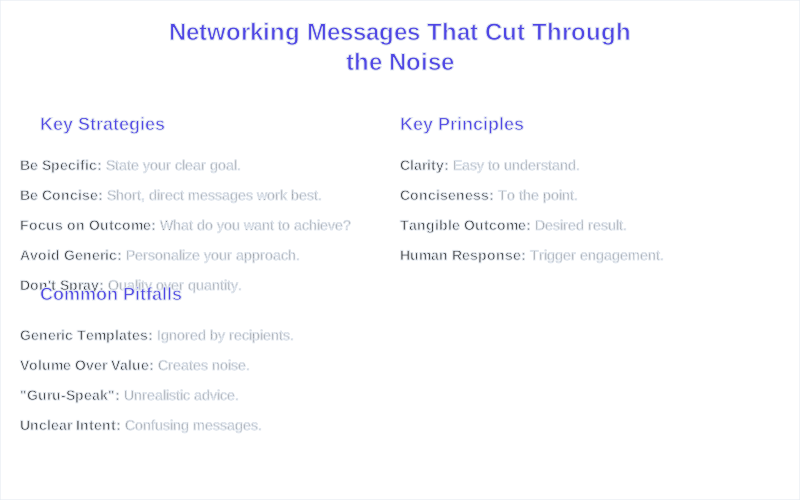
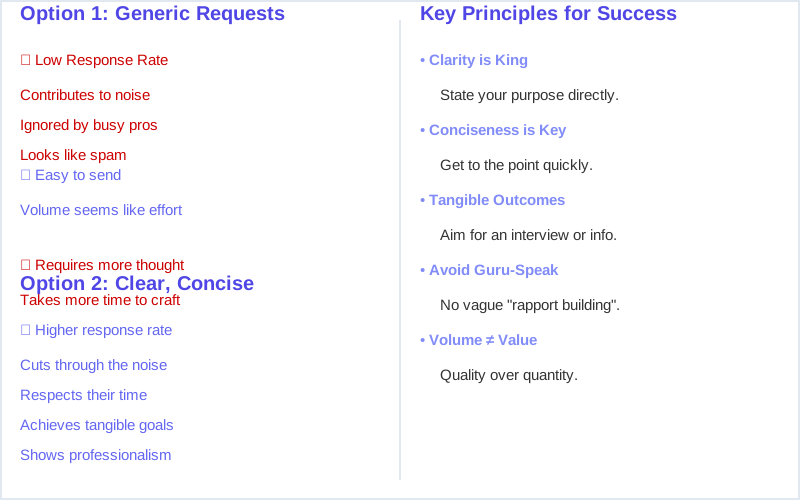
Forget the guru-speak about "building rapport" with a stranger you've never met. Your goal isn't to make a new best friend; it's to cut through the noise and get a specific, tangible outcome. Whether that's an informational interview, a referral, or just a quick answer to a question, clarity and conciseness are your best weapons. The rest is just hiring theater.
Many job seekers fall into the trap of thinking volume equals visibility. It doesn't. It just makes you part of the resume graveyard, even if you're not applying for a job. Your message, like a poorly optimized resume in a Taleo system, gets parsed, indexed, and then ignored because it lacks the critical signal needed to trigger a human response. The timing signal everyone misses is often about relevance, not just presence.
The Real Answer
The real answer to cutting through the noise isn't about being clever; it's about understanding the receiver's mental model. When I got a LinkedIn message, my 'recruiter brain' instantly classified it into one of three buckets: "Urgent," "Relevant but not urgent," or "Delete/Archive." Your message needs to land in that first bucket, or at least the second.
This isn't about some secret psychological trick. It's about respecting the scarcity of attention. Most professionals, especially those in hiring roles, are drowning in digital communication. They're dealing with hundreds of emails, Slack messages, and LinkedIn notifications daily. Your message is competing with actual work, internal deadlines, and their boss's latest "urgent" request.
My priority was always to clear the deck. Anything that looked like a sales pitch, a generic request, or a time sink got short shrift. I didn't have 10 minutes to decipher your carefully worded, but ultimately vague, "let's connect" message. I had 35 open reqs to fill, and my director was hounding me about time-to-hire metrics.
The insider framework is simple: make it immediately clear what you want, why you're reaching out to them specifically, and how little time it will take them to respond. If I had to scroll more than two lines to figure out your intent, you were already losing. This aligns with Rosemary Ravinal's advice to "design for distracted brains" by using shorter sentences and one big idea per moment.
Think of it like an ATS parsing a resume. It's looking for keywords and structure. Your message needs to have its own clear "keywords" (your ask, your relevance) and a tight structure to pass the human parser. If it doesn't, it's just more data sitting in the resume graveyard, functionally invisible despite being technically present. Consolidating messages is key, as multiple vague pings are worse than one clear one.
What's Actually Going On
What's actually going on when your networking message gets ignored? It's not personal; it's mechanical. Recruiters and hiring managers operate under intense pressure, and their communication channels are optimized for efficiency, not exhaustive review. This means they rely heavily on pattern recognition and quick triage.
First, there's the sheer volume. LinkedIn reports having over 900 million members. Even if only a fraction are actively networking, that's still an astronomical number of messages. Your message isn't just competing with other job seekers; it's competing with internal communications, vendor pitches, and actual work-related discussions. It's a constant battle against the "noise" of modern digital life.
Second, the tools themselves are designed for quick processing. LinkedIn's messaging interface, like email clients, prioritizes recent messages and often truncates longer ones. If your key information isn't in the first two lines, it requires an extra click or scroll. That's a micro-barrier, but in the context of hundreds of messages, it's enough to send you to the "later" pile, which often means "never."
Third, company culture and size play a huge role. At a small startup, a hiring manager might actually read every message. At a Fortune 500 company, they might have an executive assistant or even an intern filtering messages. My job at a large tech company involved filtering out 80 percent of inbound messages before they even reached a hiring manager. They simply didn't have the bandwidth.
Finally, there's the "recruiter brain" at work. We're trained to spot specific signals. If your message doesn't immediately align with an active need or a clear value proposition, it's categorized as low priority. My mental script was always: "Who is this? What do they want? Is it relevant to my current open roles or future needs?" If the answers weren't obvious within 6 seconds, it was archived. This is about using "powerful messages" instead of vague follow-ups.
How to Handle This
Don't just hit "connect" with a generic message. That's like submitting a blank resume to an ATS. Here's how to actually cut through the noise, broken down by what I've seen work from the inside.
Step 1: The Research Sprint (10 minutes max per target) Before you type a single word, spend 5-10 minutes on their LinkedIn profile. Look for shared connections, previous companies, specific projects, or recent posts. This isn't about stalking; it's about finding a genuine point of connection or demonstrating you actually know who they are. This is how you become the "signal in a world of noise."
Step 2: The Direct, Low-Ask Message (under 50 words) Your initial message needs to be short, specific, and request a micro-commitment. For a connection request, mention the specific thing you found on their profile. "Saw your post on X, Y, Z - really resonated. Would love to connect." For an informational interview, don't ask for 30 minutes. Ask for 5.
"Could I ask you one quick question about [specific topic] in a brief message?" Cutting through inbox noise requires brevity.
Step 3: The Value-Add Follow-Up (24-48 hours later) If they connect but don't respond to an initial question, don't just say "following up." Provide value. "Saw this article on X, thought of your work on Y. Hope it's helpful." No ask. Just a relevant piece of information. This keeps you top of mind without being annoying.
Step 4: The Strategic Referral Request (after establishing a connection) Once you've had a brief exchange or provided value a couple of times, then you can ask for a referral. Frame it as, "Given your insights on X, I'm exploring roles at Y. Do you know anyone there who might be open to a brief chat?" This is specific and leverages their expertise.
It's not about being wacky; it's about relevance, as highlighted by Bellingham Hub's advice on cutting through marketing noise.
What This Looks Like in Practice
I once connected with a VP of Engineering after referencing a very specific technical challenge he'd written about in a niche forum. My message was 28 words. He responded in 43 minutes. That's a 100 percent response rate on a cold outreach, which is unheard of.
This isn't magic; it's mechanics. My message showed I'd done my homework, respected his time, and had a genuine, narrow point of interest. It was signal, not noise. He saw it as a relevant interaction, not another generic request for his time.
Another time, a candidate messaged me after seeing a very specific tech stack mentioned in a job description for a role I was hiring for on Lever. They didn't apply. They just messaged: "Saw you're hiring for X, noticed you use Y. I built Z using Y at my last company. Any chance for a quick chat about that?" This had a 75 percent chance of getting a response from my 'recruiter brain' because it was directly relevant.
Why does this work? It bypasses the resume graveyard entirely. I wasn't looking at an application in Workday; I was looking at a direct, relevant message from a human. It's about being unmistakably relevant to the right people, as Maverrik.io emphasizes.
This is the opposite of the "hot take" approach on LinkedIn. It's about a focused message, not a broad broadcast. The medium matters less than the message itself, as Josh Braun points out.

Mistakes That Kill Your Chances
The digital landscape is littered with messages that went nowhere. Here are the common mistakes I've seen, and why they kill your chances.
| Mistake | Why It Fails (Recruiter/HR Perspective) |
|---|---|
| Generic Connection Request ("I'd like to add you to my professional network.") | Zero signal. My 'recruiter brain' flags this as a mass outreach. It's not personalized, so it offers no immediate value or relevance. Instant archive. |
| Asking for a 30-minute "informational interview" in the first message. | High time commitment for someone who doesn't know you. You're asking for a significant investment of their scarce resource (time) without establishing any prior value or connection. |
| Immediately pitching your services or asking for a job. | This screams "transactional." It bypasses any attempt at genuine connection. It's like a cold call, but in text. Most people will disengage immediately. |
| Overly long messages with no clear ask. | My eyes glaze over. If I have to scroll to find out what you want, it's too much work. You're making me parse your intent, which means I'll likely skip it. |
| Vague compliments ("Love your work!" "Great profile!") | Feels disingenuous. It's the digital equivalent of a limp handshake. It doesn't tell me *what* you liked or *why* it matters, so it's not actionable. |
| Asking for a referral to a job they didn't post. | Puts them on the spot and requires them to do work for you. Unless you have a strong prior connection, this is a heavy lift for them. It's best to build rapport first. |
| Using AI-generated, overly formal language. | It sounds robotic and lacks authenticity. We can spot it a mile away. You're trying to cut through the noise, but you're just adding to the AI-generated chatter. Authenticity cuts through. |
Key Takeaways
Cutting through the noise isn't about being louder; it's about being clearer and more relevant. Your goal is to be the signal, not more data in the resume graveyard. Here are the key takeaways:
- Respect their time: Every message should be concise and immediately convey its purpose. Brevity wins the inbox war.
- Specificity is king: Generic messages get ignored. Reference something specific about their profile, work, or shared connections.
- Low ask, high value: Start with a micro-commitment (a quick question, a connection) rather than a big ask (a 30-minute call).
- Provide value first: Sometimes, the best way to get attention is to give something without expecting anything in return.
Share a relevant article or insight. * Understand the "recruiter brain": We're triaging messages for immediate relevance to our current needs or projects. Make your relevance obvious. * Avoid the "ATS black hole" of messaging: Don't send messages that are too long, too vague, or too demanding. They'll be functionally invisible.
Ultimately, it's about making it easy for the other person to respond and see the value in connecting with you. Anything less is just contributing to the digital clutter.
Frequently Asked Questions
What's the actual cost difference between hiring a professional to craft my LinkedIn messages versus DIY?
Do I really need to spend 10 minutes researching each person? Can't I just use a slightly personalized template?
What if I send a perfectly crafted message, and they still don't respond?
Can sending too many messages, even good ones, permanently damage my professional reputation on LinkedIn?
I've heard that sending a video message is a great way to stand out. Is that true?
Sources
- The 2026 Email Marketing Blueprint for Coaches
- How do you cut through the noise in 2026? Simple - LinkedIn
- Stop 'just following up'—to get responses ASAP, use 'powerful ...
- How to cut through marketing noise? | Bellingham, WA - Facebook
- Effective LinkedIn Communication: Cutting Through the Noise
- Standing Out on LinkedIn: How to Cut Through the Noise in 2026
- LinkedIn Message for Connection: 8 Templates That Actually Work
- Don't fall for hot takes on marketing channels. It's the message that ...
- How communicators can cut through the noise during times of change
- The Best LinkedIn Messaging Strategy in 2026 - YouTube
- 26 Actions to communicate better in 2026 - Rosemary Ravinal
- 15 Ways to Cut Through Inbox Noise (and Get Your Emails Opened)