
Navigating Career Gaps During a Pivot: Perception Vs. Reality (2026 Complete Guide)
I once saw a resume come through Workday for a Director of Marketing role where the candidate had a two-year gap, explained only as 'personal development.' That's it. Two words. You know how many times my recruiter brain paused on that?

What's Actually Going On
When your resume hits my desk, or more accurately, my Greenhouse dashboard, the first thing I'm looking for is a clean, chronological narrative. A career gap, even for a strategic pivot, disrupts that. It's not personal; it's about how the system works and how I'm incentivized. CA Global Headhunters emphasizes strategic pivots, not impulsive ones.
ATS Data Processing
Modern ATS platforms like Greenhouse, Lever, and Workday are built on structured data. They parse your resume into fields: Job Title, Company, Start Date, End Date. A gap registers as missing data. If you try to force a 'sabbatical' into a 'job title' field, it often gets miscategorized or ignored, making your profile less searchable.
Recruiter Workflow Efficiency
I'm typically juggling 20-30 open requisitions. My goal is to move candidates from 'applied' to 'interview' as quickly as possible. A gap means I have to pause, investigate, and potentially justify to a hiring manager. That's extra work, and frankly, I often don't have the 43 seconds to spare when there are 100 other applications.
Hiring Committee Dynamics
Mid-size and larger companies often use hiring committees. These groups thrive on clear, low-risk candidates. A gap, if not seamlessly integrated into a compelling pivot story, can create unnecessary questions. It's not about malice; it's about minimizing perceived risk for a collective decision. Nikkia Reveillac talks about navigating change and the importance of a clear story.
Company-Size Variations
Startups (50-250 employees) are often more flexible with gaps and pivots. They're looking for hustle and transferable skills. Larger enterprises (1000+ employees) are more rigid. Their HR policies often have explicit guidelines for 'time out of workforce' or require specific justifications for non-linear career paths. Your mileage will vary depending on who you're applying to.
Regulatory and Compliance Facts
In some regulated industries, long gaps can trigger additional background checks or compliance questions. While not common for most roles, it's another layer of complexity that a recruiter might want to avoid if they have simpler options. This is especially true for roles requiring specific certifications or security clearances.


1. Own the Narrative, Don't Hide It
Don't try to obscure dates or omit entire sections. My recruiter brain will spot that immediately, and it looks shifty. Instead, create a dedicated entry for your gap. For example, 'Career Break - Personal Development & Skill Acquisition (Jan 2024 - Jan 2026).' This signals transparency and purpose.2. Quantify Your 'Gap' Activities
This is where you turn a potential negative into a positive. Did you volunteer? Learn a new language? Complete online courses? For that 'Personal Development' entry, list bullet points just like you would for a job. 'Completed 4 Coursera certifications in AI/ML,' or 'Managed a 10-person volunteer team for XYZ charity, increasing fundraising by 15 percent.' Use numbers. Facebook career groups discuss adding reality to your plans.3. Leverage a Functional or Hybrid Resume Format
For a true pivot with a significant gap, a chronological resume can highlight the gap unnecessarily. Consider a functional resume (skills-focused) or a hybrid format (combining skills with a brief chronological history). This allows you to lead with your transferable skills and relevant projects, downplaying the chronological breaks.4. Craft a Compelling Cover Letter (Yes, Really)
Most recruiters skim cover letters for keywords. For a pivot with a gap, it's your chance to tell the story your resume can't. Explicitly connect your past experience and your gap activities to the new role. 'During my two-year career break, I strategically focused on X, Y, and Z skills, which I believe directly translate to the needs of your [New Role] position.'5. Network, Network, Network
When you're pivoting, especially with a gap, referrals are gold. A personal recommendation from an internal employee can bypass some of the initial ATS scrutiny and get your resume directly to a human. This is your best defense against the 'resume graveyard.'6. Consider Professional Resume Services (Strategic Investment)
If you're truly stuck, a professional resume writer specializing in career pivots can be a game-changer. Expect to pay anywhere from $300 to $1,500, depending on experience. Look for someone who understands ATS mechanics and can help you identify and articulate transferable skills. Ask them about their success rate with clients who have career gaps and their familiarity with your target industry. This isn't just about pretty formatting; it's about strategic keyword optimization and narrative construction.

Scenario 1: The 'Stay-at-Home Parent' Pivot
Metrics: 2-5 year gap, high transferable soft skills (organization, negotiation, budgeting). Reality: Many companies are now actively seeking this demographic due to diversity initiatives and recognition of undervalued skills. The challenge is translating 'managing household budget' into 'managed a $500k operational budget' on the resume.Scenario 2: The 'Burnout Sabbatical' Pivot
Metrics: 6-18 month gap, often self-funded travel or personal projects. Reality: This is easier to explain. Frame it as 'strategic personal development' or 'recharge for renewed focus.' The key is to show you weren't just binging Netflix. Did you learn a new language? Volunteer for 10 hours a week? That's what I want to see.Scenario 3: The 'Unemployment Gap' Pivot
Metrics: Variable length, often involuntary. Reality: This is the hardest. The perception can be that you were unhireable. Combat this by showing continuous learning (online courses), networking activities, or even freelance projects during the gap. A 6-month unemployment gap with 3 certifications in the target field looks a lot different than 6 months of silence.Scenario 4: The 'Entrepreneurial Venture' Pivot
Metrics: 1-3 year gap, often involves starting and failing a business. Reality: This is a goldmine for transferable skills. Don't hide the 'failure.' Frame it as 'founded and led X startup, managing Y budget and Z team, gaining critical experience in sales, marketing, and product development.' Recruiters love this drive, especially for roles in startups or innovation.

| Mistake | The Real Reason It Kills Your Chances |
| 1. Omitting the gap entirely or fudging dates. | My recruiter brain sees inconsistent dates in Workday and immediately flags it as suspicious. It's a trust killer. Better to explain it than to look like you're hiding something. |
| 2. Generic 'personal reasons' as an explanation. | This tells me nothing. It's pure noise. I don't need a therapy session; I need to know if you were actively developing skills or just chilling. My goal is to find a plausible candidate, not a mystery novel. |
| 3. Not translating 'gap' activities into business value. | 'Traveled Europe' doesn't help me. 'Managed a travel budget of $10,000 for 6 months, coordinating logistics for 5 countries' does. Translate your experience into quantifiable achievements relevant to the new role. |
| 4. Applying to roles far below your previous experience without explanation. | This screams 'desperate' or 'flaky' to a hiring manager. If you're taking a step back for a strategic pivot, explain *why* it's strategic. Otherwise, it looks like you couldn't get anything else. |
| 5. Using an outdated or overly creative resume format. | Taleo or iCIMS will mangle anything that isn't a standard, clean format. Two-column layouts, fancy fonts, or embedded graphics are prime candidates for the ATS black hole. Keep it simple for parsing. |
| 6. Relying solely on online applications. | For a pivot with a gap, you need internal champions. Without networking, you're just another resume in the resume graveyard, hoping my generic search terms miraculously pick you out. That's a low-probability bet. |
| 7. Not updating your LinkedIn profile to reflect the pivot. | Your LinkedIn is often the first place I go after skimming your resume. If it doesn't align, or worse, still shows you in your old career, it's a disconnect. It needs to tell the same story as your resume. |
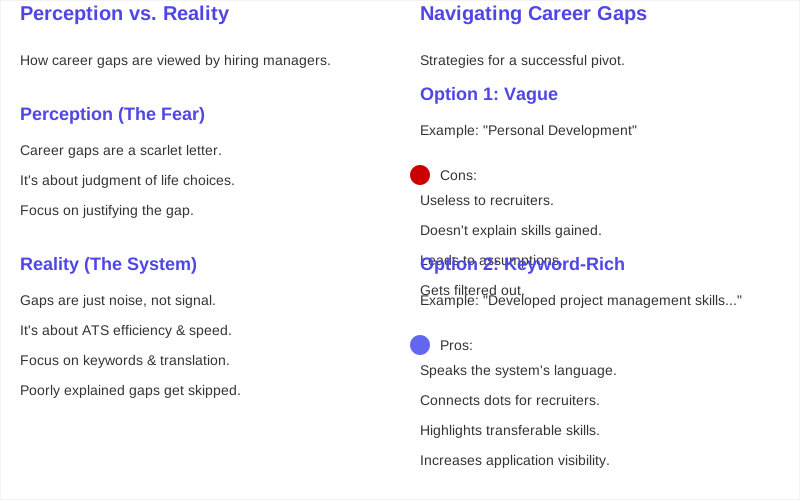
- Own Your Narrative: Explicitly address the gap on your resume. Don't leave it to my recruiter brain to guess.
- Quantify Everything: Turn 'time off' into 'achievements.' Even non-traditional experiences can be translated into valuable skills with numbers and impact statements.
- Target Your Tools: Understand that ATS systems like Workday and Greenhouse are looking for specific data points. Format your resume for machine readability first, then human appeal.
- Network Relentlessly: Referrals are your golden ticket past the initial screening algorithms and into the hands of a human who can appreciate your story.
- Be a Storyteller: Your cover letter and interview answers are where you weave your gap and pivot into a compelling, logical career trajectory.
Frequently Asked Questions
I'm considering paying for a professional resume writer to help with my pivot and gap. Is it worth the $500-1500, or should I just use a template?
My resume has a 'Professional Sabbatical' section for my 1.5-year gap. Do I need to list specific dates for activities within that sabbatical, or is just the overall start/end date enough?
What if I meticulously explain my career gap and pivot, but I still only get rejections or no responses? Does that mean my gap is just too long?
Could having multiple, short career gaps (e.g., 3-6 months each over 5 years) permanently damage my career prospects, even if I explain each one?
I heard that putting 'CEO of My Household' for a parenting gap is a clever way to frame it. Is this true?
Sources
- Navigating a Career Pivot: How to Transition Without Starting Over
- How to bridge the gap between perception and reality in your career
- A Step-by-Step Guide for a Career Pivot - CA Global
- Feeling stuck in your job search heading into 2026. You're not alone ...
- Be honest. When you've thought about changing careers, where did ...
- Preparing for a Career Change: a Step-by-Step Guide for 2026
- Career Pivot: Assessing Signals for Change | Emma Grede posted ...
- Managers, why are you concerned about gaps in employment?
- What It Really Takes to Make a Career Pivot with Nikkia Reveillac
- The Complete Guide to Changing Careers in 2026: How to Pivot ...
- 2026 Job Search Reality Check: What's Changing and How to Adapt