
How to Evaluate AI Startup Job Offers and Their Equity Structures (2026 Complete Guide)
You just got an AI startup job offer, and the equity line says '0.1 percent.' You're probably thinking, 'Is that good? Is it worth the 15 percent pay cut from my FAANG base salary?' The truth is, that number alone means absolutely nothing.
You just got an AI startup job offer, and the equity line says '0.1 percent.' You're probably thinking, 'Is that good? Is it worth the 15 percent pay cut from my FAANG base salary?' The truth is, that number alone means absolutely nothing. It's like being told a car has '4 wheels' and asking if it's a good deal. Your AI Hiring Tool Evaluation Checklist won't tell you how to value an offer, but I will.
The Real Answer
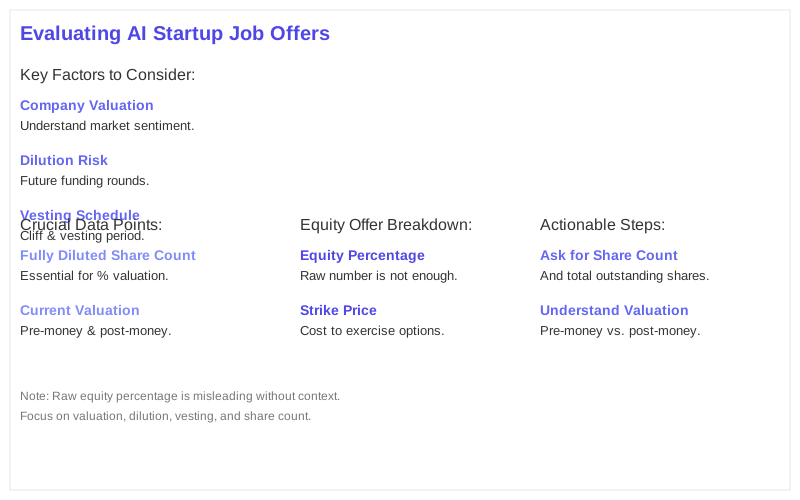
The real answer to evaluating an AI startup offer isn't about the raw equity percentage; it's about understanding the company's valuation, dilution risk, and vesting schedule. Most AI career guides skip this part. They focus on the 'learn Python' stage, not the 'don't get screwed by your cap table' stage. MIT Career Services breaks down equity, but they don't give you the gut feeling.


What's Actually Going On
What's actually going on is a complex dance between a startup's funding stage, its burn rate, and the prevailing market sentiment for AI companies. In 2025, OpenAI's valuation soared to $500 billion, while Anthropic hit $183 billion. These numbers drive the dreams, but your offer is based on much smaller realities. Understanding AI business valuation models is key.


How to Handle This
When you get that offer, don't just stare at the equity percentage. Your first step is to ask for the current fully diluted share count. This is crucial. Without it, your 0.1 percent means nothing. You need to know the total number of shares outstanding, including all options and convertible notes. Levels.fyi has a good guide on evaluating startup offers, but they don't tell you how to get this info.


What This Looks Like in Practice
Let's say you get an offer for a Senior ML Engineer role at a Series A startup. Your base salary is $160,000, and they offer 0.2 percent equity. The company just raised $20 million at a $100 million post-money valuation. So, your equity is theoretically worth $200,000. Top Startups' database shows a software engineer at a Series A with 0.12 percent at a $150M valuation.

Mistakes That Kill Your Chances
Mistakes That Kill Your Chances
| Mistake | Operational Reality Check |
|---|---|
| Ignoring the vesting schedule | A 4-year vest with a 1-year cliff means you get nothing if you leave in 11 months. That 0.1 percent is locked away. |
| Not understanding dilution | That 0.1 percent today can become 0.05 percent after the next funding round. Your slice of the pie shrinks. |
| Overvaluing illiquid equity | Your paper wealth isn't cash. You can't pay rent with 'future potential.' Talent, pay, and readiness reports often miss this nuance. |
| Not asking about preferred vs. common stock | As an employee, you get common stock. Investors get preferred, meaning they get paid first if the company sells. |
| Failing to negotiate salary first | Equity is a lottery ticket. Your salary is guaranteed. Maximize the sure thing before betting on the uncertain. |
| Assuming a quick exit | Most startups don't exit in 2-3 years. Expect 5-10 years, or never. Patience is a virtue, but so is a steady paycheck. |
Key Takeaways
When evaluating an AI startup offer, you need to look past the shiny numbers and understand the mechanics. It's not about the logo, it's about the math. Here's the drill:
Frequently Asked Questions
What's the real cost difference between hiring a lawyer to review my offer versus just trusting the startup's standard terms?
Do I really need to understand the company's cap table, or can I just trust the recruiter's explanation of my equity?
What if I negotiate aggressively on equity, and they just pull the offer?
Can a bad equity deal permanently damage my career trajectory or financial health?
I heard that joining a pre-seed startup means you get a much larger equity slice. Is that always a good thing?
Sources
- AI Business Valuation Model 2026: Methods, Metrics & Trends for ...
- How to evaluate startup offers - MIT Career Services
- Startup Salary & Equity Compensation 2026 - Top Startups
- AI Hiring in 2026: Talent, Pay & Readiness - Hunt Scanlon Media
- Your AI Hiring Tool Evaluation Checklist (2026 Guide for HR ...
- How to Evaluate Startup Offers - Levels.fyi